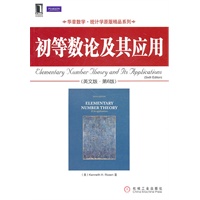
| 本书是数论课程的经典教材,自出版以来,深受读者好评,被美国加州大学伯克利分校、伊利诺伊大学、得克萨斯大学等数百所名校采用。 本书以经典理论与现代应用相结合的方式介绍了初等数论的基本概念和方法,内容包括整除、同余、二次剩余、原根以及整数的阶的讨论和计算。 |
| Kenneth H.Rosen,1972年获密歇根大学数学学士学位,1976年获麻省理工学院数学博士学位,1982年加入贝尔实验室,现为AT & T实验室特别成员,国际知名的计算机数学专家。Rosen博士对数论领域与数学建模领域颇有研究,并写过很多经典论文及专著。他的经典著作《离散数学及其应用》的中文版和影印版均已由机械工业出版社引进出版。 |
| Preface List of Symbols What Is Number Theory? 1 The Integers 1.1 Numbers and Sequences 1.2 Sums and Products 1.3 Mathematical Induction 1.4 The Fibonacci Numbers 1.5 Divisibility 2 Integer Representations and Operations 2.1 Representations of Integers 2.2 Computer Operations with Integers 2.3 Complexity of Integer Operations 3 Primes and Greatest Common Divisors 3.1 Prime Numbers 3.2 The Distribution of Primes 3.3 Greatest Common Divisors and their Properties 3.4 The Euclidean Algorithm 3.5 The Fundamental Theorem of Arithmetic 3.6 Factorization Methods and the Fermat Numbers 3.7 Linear Diophantine Equations 4 Congruences 4.1 Introduction to Congruences 4.2 Linear Congruences 4.3 The Chinese Remainder Theorem 4.4 Solving Polynomial Congruences 4.5 Systems of Linear Congruences 4.6 Factoring Using the Pollard Rho Method 5 Applications of Congruences 5.1 Divisibility Tests 5.2 The Perpetual Calendar 5.3 Round-Robin Tournaments 5.4 Hashing Functions 5.5 Check Dieits 6 Some Special Congruences 6.1 Wilson's Theorem and Fermat's Little Theorem 6.2 Pseudoprimes 6.3 Euler's Theorem 7 Multiplicative Functions 7.1 The Euler Phi-Function 7.2 The Sum and Number of Divisors 7.3 Perfect Numbers and Mersenne Primes 7.4 M6bius Inversion 7.5 Partitions 8 Cryptology 8.1 Character Ciphers 8.2 Block and Stream Ciphers 8.3 Exponentiation Ciphers 8.4 Public Key Cryptography 8.5 Knapsack Ciphers 8.6 Cryptographic Protocols and Applications 9 Primitive Roots 9.1 The Order of an Integer and Primitive Roots 9.2 Primitive Roots for Primes 9.3 The Existence of Primitive Roots 9.4 Discrete Logarithms and Index Arithmetic 9.5 Primality Tests Using Orders of Integers and Primitive Roots 9.6 Universal Exponents 10 Applications of Primitive Roots and the Order of an Integer 10.1 Pseudorandom Numbers 10.2 The E1Gamal Cryptosystem 10.3 An Application to the Splicing of Telephone Cables 11 Quadratic Residues 11.1 Quadratic Residues and Nonresidues 11.2 The Law of Quadratic Reciprocity 11.3 The Jacobi Symbol 11.4 Euler Pseudoprimes 11.5 Zero-Knowledge Proofs 12 Decimal Fractions and Continued Fractions 12.1 Decimal Fractions 12.2 Finite Continued Fractions 12.3 Infinite Continued Fractions 12.4 Periodic Continued Fractions 12.5 Factoring Using Continued Fractions 13 Some Nonlinear Diophantine Equations 13.1 Pythagorean Triples 13.2 Fermat's Last Theorem 13.3 Sums of Squares 13.4 Pell's Equation 13.5 Congruent Numbers 14 The Gaussian Integers 14.1 Gaussian Integers and Gaussian Primes 14.2 Greatest Common Divisors and Unique Factorization 14.3 Gaussian Integers and Sums of Squares Appendix A Axioms for the Set of Integers Appendix B Binomial Coefficients Appendix C Using Maple and Mathematica for Number Theory C.1 Using Maple for Number Theory C.2 Using Mathematica for Number Theory Appendix D Number Theory Web Links Appendix E Tables Answers to Odd-Numbered Exercises Bibliography Index of Biographies Index Photo Credits |


 内容加载中,请稍后...







商品评论(0条)