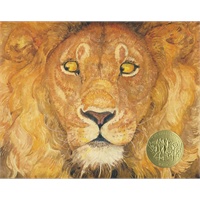
This story starts on the cover with the glorious, golden
countenance of a lion. No text is necessary to communicate the
title: the direction of the beast's gaze and the conflicted
expression on his tightly cropped face compel readers to turn the
book over, where a mouse, almost filling the vertical space,
glances back. The endpapers and artist's note place these creatures
among the animal families of the African Serengeti. Each spread
contributes something new in this nearly wordless narrative,
including the title opening, on which the watchful rodent pauses,
resting in one of the large footprints that marches across the
gutter. In some scenes, Pinkney's luminous art, rendered in
watercolor and colored pencil, suggests a natural harmony, as when
the cool blues of the sky are mirrored in the rocks and acacia
tree. In other compositions, a cream-colored background focuses
attention on the exquisitely detailed and nuanced forms of the two
main characters. Varied perspectives and the judicious use of
panels create interest and indicate time. Sounds are used sparingly
and purposefully—an owl's hoot to hint at offstage danger or an
anguished roar to alert the mouse of the lion's entrapment.
Contrast this version with Pinkney's traditional treatment of the
same story (complete with moral) in Aesop's Fables (North-South,
2000). The ambiguity that results from the lack of words in this
version allows for a slower, subtle, and ultimately more satisfying
read. Moments of humor and affection complement the drama. A
classic tale from a consummate artist.
|



 内容加载中,请稍后...


商品评论(0条)