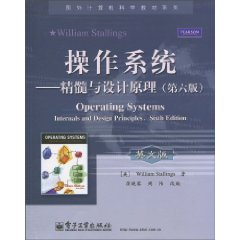
| 《操作系统:精髓与设计原理(第6版)(英文版)》是畅销书作者William stallirigs的力作,其第四版曾获得美国计算机科学与工程类教材大奖。《操作系统:精髓与设计原理(第6版)(英文版)》清晰、完整地讲解了现代操作系统的概念、结构和机制。这个新版本进行了完整的更新,以反映行业的最新进展。 作者全面分析了操作系统设计的高级目标和挑战,然后在每个主要领域给出了权威的讲解:线程、并发性、内存管理、虚拟内存、处理器调度、输入/输出管理以及文件管理等。对每个领域,都用现实世界的例子进行了演示,从而强化了这些讨论。这些例子基于Windows Vista、LINIX、Unux以及其他同时期的操作系统。 不管是研究人员还是专业读者,《操作系统:精髓与设计原理(第6版)(英文版)》都是理想的读物。全书讲解清晰、结构合理,并包含大量的教学支持材料,包括数百个经过仔细构思的实践性问题。 主要特点 为了使复杂的概念更清晰、更易理解,集成了新的动画 项目支持,包括两个手工编程项目、研究项目、阅读/撰写报告任务以及写作任务 配套网站WilliarT]Stalli rlgs.COlTI/OS/OS6e.html上的大量Web内容支持 丰富的关键字/缩略词清单、推荐读物、词汇表等 涵盖内容 大量的Wirldows例子,针对Wirldows Vista 系统进行了全面更新 扩充并优化了并发性的内容 全面讲解进程控制、线程、SMP和微内核 对单处理器、多处理器和实时调度进行了详细探讨 全面介绍如何管理内存、I/O、磁盘和文件 |
| Chapter 1 Computer System Overview 1 1.1 Basic Elements 1 1.2 Processor Registers 2 1.3 Instruction Execution 5 1.4 Interrupts 8 1.5 The Memory Hierarchy 19 1.6 Cache Memory 22 1.7 I/O Communication Techniques 26 1.8 Recommended Reading and Web Sites 29 1.9 KeyTerms, Review Questions, and Problems 30 Appendix 1A Performance Characteristics of Two-Level Memory 32 Appendix 1B Procedure Control 39 Chapter 2 Operating System Overview 43 2.1 Operating System Objectives and Functions 43 2.2 The Evolution of Operating Systems 47 2.3 Major Achievements 56 2.4 Developments Leading to Modern Operating Systems 69 2.5 Microsoft Windows Overview 72 2.6 Traditional UNIX Systems 82 2.7 Modern UNIX Systems 85 2.8 Linux 86 2.9 Recommended Reading and Web Sites 93 2.10Key Terms, Review Questions, and Problems 95 Chapter 3 Process Description and Control 97 3.1 What is a Process? 97 3.2 Process States 100 3.3 Process Description 115 3.4 Process Control 124 3.5 Execution of the Operating System 129 3.6 Security Issues 132 3.7 UNIX SVR4 Process Management 136 3.8 Summary 141 3.9 Recommended Reading 142 3.10KeyTerms, Review Questions, and Problems 142 Programming Project One Developing a Shell 146 Chapter 4 Threads, SMP, and Microkernels 149 4.1 Processes andThreads 149 4.2 Symmetric Multiprocessing (SMP) 163 4.3 Microkernels 167 4.4 WindowsVista Thread and SMP Management 173 4.5 Solaris Thread and SMP Management 178 4.6 Linux Process andThread Management 183 4.7 Summary 186 4.8 Recommended Reading 187 4.9 KeyTerms, Review Questions, and Problems 188 Chapter 5 Concurrency: Mutual Exclusion and Synchronization 193 5.1 Principles of Concurrency 194 5.2 Mutual Exclusion: Hardware Support 203 5.3 Semaphores 206 5.4 Monitors 219 5.5 Message Passing 226 5.6 Readers/Writers Problem 232 5.7 Summary 236 5.8 Recommended Reading 237 5.9 Key Terms, Review Questions, and Problems 238 Chapter 6 Concurrency: Deadlock and Starvation 249 6.1 Principles of Deadlock 249 6.2 Deadlock Prevention 258 6.3 Deadlock Avoidance 259 6.4 Deadlock Detection 265 6.5 An Integrated Deadlock Strategy 267 6.6 Dining Philosophers Problem 268 6.7 UNIX Concurrency Mechanisms 272 6.8 Linux Kernel Concurrency Mechanisms 275 6.9 Solaris Thread Synchronization Primitives 281 6.10Windows Vista Concurrency Mechanisms 284 6.11Summary 288 6.12Recommended Reading 288 6.13Key Terms, Review Questions, and Problems 289 Chapter 7 Memory Management 295 7.1 Memory Management Requirements 295 7.2 Memory Partitioning 298 7.3 Paging 309 7.4 Segmentation 313 7.5 Security Issues 314 7.6 Summary 318 7.7 Recommended Reading 318 7.8 Key Terms, Review Questions, and Problems 319 Appendix 7A Loading and Linking 321 Chapter 8 Virtual Memory 328 8.1 Hardware and Control Structures 328 8.2 Operating System Software 347 8.3 UNIX and Solaris Memory Management 365 8.4 Linux Memory Management 371 8.5 WindowsVista Memory Management 373 8.6 Summary 376 8.7 Recommended Reading and Web Sites 377 8.8 Key Terms, Review Questions, and Problems 378 Appendix 8A Hash Tables 382 Chapter 9 Uniprocessor Scheduling 386 9.1 Types of Scheduling 386 9.2 Scheduling Algorithms 390 9.3 Traditional UNIX Scheduling 412 9.4 Summary 414 9.5 Recommended Reading 414 9.6 Key Terms, Review Questions, and Problems 415 Appendix 9A Response Time 418 Appendix 9B Queuing Systems 420 Programming Project Two The HOST Dispatcher Shell 427 Chapter 10 Multiprocessor and Real-Time Scheduling 432 10.1 Multiprocessor Scheduling 432 10.2 Real-Time Scheduling 445 10.3 Linux Scheduling 460 10.4 UNIX FreeBSD Scheduling 464 10.5Windows Vista Scheduling 466 10.6 Summary 469 10.7 Recommended Reading 469 10.8 Key Terms, Review Questions, and Problems 470 Chapter 11 I/O Management and Disk Scheduling 473 11.1 I/O Devices 473 11.2Organization of the I/O Function 474 11.3 Operating System Design Issues 478 11.4 I/O Buffering 481 11.5 Disk Scheduling 484 11.6 RAID 491 11.7 Disk Cache 500 11.8 UNIX FreeBSD I/O 503 11.9 Linux I/O 506 11.10WindowsVista I/O 510 11.11Summary 513 11.12 Recommended Reading 513 11.13Key Terms, Review Questions, and Problems 515 Appendix 11A Disk Storage Devices 517 Chapter 12 File Management 528 12.1 Overview 528 12.2 File Organization and Access 534 12.3File Directories 538 12.4 File Sharing 543 12.5Record Blocking 544 12.6Secondary Storage Management 546 12.7File System Security 554 12.8 UNIX File Management 556 12.9 Linux File Management 563 12.10WindowsVista File System 567 12.11Summary 573 12.12 Recommended Reading 573 12.13Key Terms, Review Questions, and Problems 574 Glossary 577 References 587 |
 内容加载中,请稍后...








商品评论(0条)