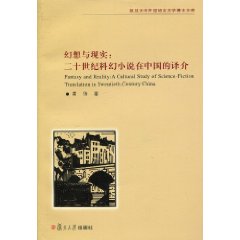
| 《幻想与现实:二十世纪科幻小说在中国的译介》为复旦大学外国语言文学博士文库。 |
| Introduction Rationale for the Study Translation history and its position in Holmes Map The definition and divisions of translation history Theoretical Preliminaries Polysystem Theory Norm Theory Multiple Causality Theory Literature Review Previous research on translation history Research on SF translation in the West and China Overview of the Book Part One Science Fiction and Its Development as a Literary Genre in China The Name and Nature of Science Fiction The Development of Chinese SF in the 20th Century The budding of Chinese SF in Late Qing and Republic periods The First Tide of Chinese SF in the 1950s The Golden Age of Chinese SF in the 1980s The Flourish of Chinese SF in the 1990s Part Two An Exploration into SF Translation in 20th-century China: Five Case Studies Yuejie Liixing ( 《月界旅行》, 1903): Epitome of the First Wave of SF Translation Jules Verne and De la Terre a la Lune (1865) Lu Xun, the Translator China in the Early 20th Century The influence of Japan The rise of publishing industry The Early 20th-Century Literature Tradition versus innovation The rise of New Fiction Translation Tendencies in Early 20th-Century China The wave of literary translation The trend of free translation Weilai Shijie (《未来世界》,1934):An Exceptional Case in the Low-tide Period of SF Translation between 1920s and 1940s H. G. Wells and The Shape of Things to come (1933) The Chinese Society in the Republic Era The influence of the May Fourth Movement The threat of war in the 1930s Literary Tendencies in the Republic Era Translation Norms in the Republic Era Shuilu Liangqi Ren (《水陆丙栖人》,1958): The Soviet Model and the Second Wave of SF Translation Alexander Belyaev and the Soviet SF Tradition The Soviet SF tradition Alexander Belyaev and The Amphibious (1928) The Chinese Society in the Early PRC Years Socialist construction and the march toward science The publishing industry after 1949 The Chinese Literature in the Early PRC Years Translation Norms in the Early PRC Years Wo, Jiqiren (《我,机器人》,1981) : Opening Up to the Outside World in the Golden Age of Chinese SF Isaac Asimov and 1, Robot (1950) The Chinese Society in the Late 1970s and Early 1980s Literary Tendencies in the Late 1970s and Early 1980s Translation Norms in the Late 1970s and Early 1980s Shenjing Langyouzhe (《神经浪游者》, 1999) :Cyberpunks First Encounter with China in the Fourth Wave of SF Translation William Gibson and Neuromancer (1984) The Chinese Society in the 1990s Economic and scientific advancement in the 1990s The influence of globalization Literary Trends in the 1990s Translation Tendencies in the 1990s Part Three Translation and the Spread of a Genre in China Science Fiction as an Imported Genre Translation and the birth of the SF genre Translation and the fiterary evolution in the genre The Concept of the Genre vs. The Policies of Translation From "science" to "fiction" : (mis) conception of the genre and its influence on SF translation Cultural elements and neologisms in SF vs. the policies of translation Conclusion Significance of the Study Possibilities for Future Research BIBLIOGRAPHY |

 内容加载中,请稍后...






商品评论(0条)