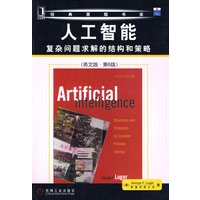
| “在该领域里学生经常遇到许罗很难的概念,通过深刻的实例与简单明了的祝圈,该书清晰而准确垲阚述了这些概念。” ——Toseph Lewis,圣迭戈州立大学 “本书是人工智能课程的完美补充。它既给读者以历史的现点,又给幽所有莰术的宾用指南。这是一本必须要推荐的人工智能的田书。” ——-Pascal Rebreyend,瑞典达拉那大学 “该书的写作风格和全面的论述使它成为人工智能领域很有价值的文献。” ——Malachy Eaton,利默里克大学 |
| George F.Luger 1973年在宾夕法尼亚大学获得博士学位,并在之后的5年间在爱丁堡大学人工智能系进行博士后研究,现在是新墨西哥大学计算机科学研究、语言学及心理学教授。 |
| Preface Publisher's Acknowledgements PART I ARTIFIClAL INTELLIGENCE:ITS ROOTS AND SCOPE 1 A1:HISTORY AND APPLICATIONS 1.1 From Eden to ENIAC:Attitudes toward Intelligence,Knowledge,andHuman Artifice 1.2 0verview ofAl Application Areas 1.3 Artificial Intelligence A Summary 1.4 Epilogue and References 1.5 Exercises PART II ARTIFlClAL INTELLIGENCE AS REPRESENTATION AN D SEARCH 2 THE PREDICATE CALCULUS 2.0 Intr0血ction 2.1 The Propositional Calculus 2.2 The Predicate Calculus 2.3 Using Inference Rules to Produce Predicate Calculus Expressions 2.4 Application:A Logic—Based Financial Advisor 2.5 Epilogue and References 2.6 Exercises 3 STRUCTURES AND STRATEGIES FOR STATE SPACE SEARCH 3.0 Introducfion 3.1 GraphTheory 3.2 Strategies for State Space Search 3.3 using the state Space to Represent Reasoning with the Predicate Calculus 3.4 Epilogue and References 3.5 Exercises 4 HEURISTIC SEARCH 4.0 Introduction 4.l Hill Climbing and Dynamic Programmin9 4.2 The Best-First Search Algorithm 4.3 Admissibility,Monotonicity,and Informedness 4.4 Using Heuristics in Games 4.5 Complexity Issues 4.6 Epilogue and References 4.7 Exercises 5 STOCHASTIC METHODS 5.0 Introduction 5.1 The Elements ofCountin9 5.2 Elements ofProbabilityTheory 5.3 Applications ofthe Stochastic Methodology 5.4 Bayes’Theorem 5.5 Epilogue and References 5.6 Exercises 6 coNTROL AND IMPLEMENTATION OF STATE SPACE SEARCH 6.0 Introduction l93 6.1 Recursion.Based Search 6.2 Production Systems 6.3 The Blackboard Architecture for Problem Solvin9 6.4 Epilogue and References 6.5 Exercises PARTIII CAPTURING INTELLIGENCE:THE AI CHALLENGE 7 KNOWLEDGE REPRESENTATION 7.0 Issues in Knowledge Representation 7.1 A BriefHistory ofAI Representational Systems …… 8 STRONG METHOD PROBLEM SOLVING 9 REASONING IN UNCERTAIN SITUATIONS PART Ⅳ MACHINE LEARNING 10 MACHINE LEARNING:SYMBOL-BASED 11 MACHINE LEARNING:CONNECTIONIST 12 MACHINE LEARNING:GENETIC AND EMERGENT 13 MACHINE LEARNING:PROBABILISTIC PART Ⅴ ADVANCED TOPICS FOR AI PROBLEM SOLVING 14 AUTOMATED REASONING 15 UNDERSTANDING NATURAL LANGUAGE PART Ⅵ EPILOGUE 16 ARTIFICIAL INTELLIGENCE AS EMPIRICAL ENQUIRY |
 内容加载中,请稍后...









商品评论(0条)