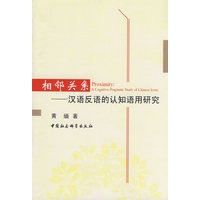
| 黄缅,女,重庆人。2008年毕业于广东外语外贸大学,获博士学位,并以优异的成绩和出色的研究成果,获广东省南粤优秀研究生称号。现任重庆工商大学外语学院副教授、研究所语言与教学小组组长,有扎实的理论基础和丰富的教学经验,曾应邀赴澳门大学和英国布莱顿大学参加国际学术会议并发言。参与主持了省部级、校级科研课题6项,撰写论文并在外语类学科级、核心刊物上发表论文9篇。 |
| 概术 List of Figures Chapter 1 Introduction 1.1 Preliminary remarks 1.2 The commitment of the study 1.3 The story of irony 1.3.1 Origin 1.3.2 Irony in Chinese context 1.3.3 Classification 1.3.4 Uses and functions 1.3.5 Summary of the section 1.4 Scope of the study 1.5 Methodological issues 1.5.1 Lead-in remarks 1.5.2 Research phases 1.6 Data 1.7 Structure of the dissertation 1.8 Summary Chapter 2 Literature Review 2.1 Introduction 2.2 Historical survey 2.2.1 Greek 2.2.2 Latins 2.2.3 Mediaeval and Renaissance 2.2.4 Early modern times 2.2.5 Modern times 2.2.6 Brief summary 2.3 Theoretical survey abroad 2.3.1 Initial remarks 2.3.2 Non-cognitive-pragmatic studies 2.3.3 Cognitive-pragmatic studies 2.3.4 Summary 2.4 Research in Chinese context 2.4.1 Preliminaries 2.4.2 Chronological survey 2.5 Remaining crucial problem 2.6 Summary Chapter 3 Theoretical Framework 3.1 Preliminaries 3.2 Methodological constraints 3.3 Theoretical background of the present study 3.3.1 Main assumptions of cognitive linguistics 3.3.2 A brief survey of cognitive pragmatics 3.3.3 Theories of human cognitive abilities 3.4 Towards a unified theoretical framework 3.4.1 MM-based pragmatic reasoning 3.4.2 Explicit expression-implicit expression inference 3.4.3 Autonomy-dependence alignment 3.5 Summary Chapter 4 Issues of Definition and Taxonomy Chapter 5 Irony as a cognitive-pragmatic Chapter 6 Mechanism of the Use of irony Redescribed Chapter 7 Conclusion Dictionaries and Encyclopedias Referred Bibliography Index 后记 |

 内容加载中,请稍后...






商品评论(0条)