最 低 价:¥42.10

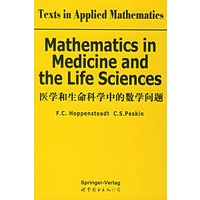
| Series Preface Preface Introduction 1 The Mathematics of Populations: Demographics 1.1. Geometric Population Growth 1.1.1. Growth of Bacterial Cultures 1.1.2. Least-Squares Estimation of the Growth Rate 1.1.3. Growth of Human Populations 1.1.4. Infinitesimal Sampling Intervals and Doubling Times 1.2. Geometric Growth in a Population Stratified by Age 1.2.1. Fibonacci's Rabbit Population 1.2.2. Euler's Renewal Equations 1.2.3. Age Structure in Human Popnlations 1.3. The Limits of Growth 1.3.1. Verhulst's Model 1.3.2. Predator Satiation 1.3.3. Chaos 1.3.4. Infimtesimal Sampling Intervals ina Limiting Environment 1.4. Age Structure of Populations near the Limits of Growth 1.5. Harvesting 1.6. Summary 1.7. Annotated References Exercises 2 Inheritance 2.1. Mendel's Laws 2.2. Bacterial Genetics: Plasmids 2.3. Genetics in Small Populations of Human. 2.4. The Hardy-Weinberg Equilibrium 2.5. Summary 2.6. Annotated References Exercises 3 A Theory of Epidemics 3.1. Spread of Infection within a Family 3.2. The Threshold of an Epidemic 3.3. Calculation of the Severity of an Epidemic 3.4. Summary 3.5. Annotated References Exercises 4 Biogeography 4.1. TheGameofLife. 4.2. Random Walks 4.3. The Diffusion Apprcndmation 4.4. The Growth of Bacteria on Plates 4.5. Another View of Random Walks 4.6. Summary 4.7. Annotated References Exercises 5 The Heart and Circulation 5.1. Plan of the Circulation 5.2. Volume, Flow, and Pressure 5.3. Resistance and Compliance Vessels 5.4. The Heart as a Pair of Pumps 5.5. Mathematical Model of the Uncontrolled Circulation 5.6. Balancing the Two Sides of the Heart andthe Two Circulations 5.7. Cardiac Output and Arterial Blood Pressure:The Need for Extemal Circulatory Control Mechanisms 5.8. Neural Control: The Baroreceptor Loop 5.9. Autoregulation 5.10. Changes in the Circulation Occurring at Birth 5.11. Dynamics of the Arterial Pulse 5.12. Annotated References, Exercises 6 Gas Exchange in the Lungs 6.1. The Ideal Gas Law and the Solubility of Gases 6.2. The Equations of Gas Transport in One Alveolus. 6.3. Gas Transport in the Lung 6.4. Optimal Gas TRansport 6.5. Mean Alveolar and Arterial Partial Pressures 6.6. Transport of O2 6.7. Annotated References Exercises 7 Control of Cell Volume anathe Electrical Properties of Cell Membranes 7.1. Osmotic Pressure and the Work of Concentration 7.2. A Simple Model of Cell Volume Control 7.3. The Movement of lons across Cell Membranes 7.4. Control of Cell Volume: The Interaction ofElectrical and Osmotic Effects 7.5. Transient Changes in Membrane Potential:A Signaling Mechanism in Nerve and Muscle 7.6. Annotated References Exercises 8 The Renal Countercurrent Mechanism 8.1. The Nephron 8.2. Differential Equations of Na+ and H2o Transportalong the Renal Tubules 8.3. The Loop of Henle 8.4. The Juxtaglomerular Apparatus andthe Renin-Angiotensin System 8.5. The Distal Tubule and Collecting Duct:Concentrating and Diluting Modes 8.6. Remarks on the Significance ofthe Juxtaglomerular Apparatus 8.7. Annotated References Exercises 9 Muscle Mechanics 9.1. The Force-Velocity Curve 9.2. Cross-Bridge Dynamics 9.3. Annotated References Exercises 10 Biological Clocks and Mechanismsof Neural Control 10.1. A Theory of Clocks 10.1.1.The Clock on the Wall 10.1.2. Pbase Resetting: A Rubber Handed CIock 10.1.3. Modulated Clocks 10.2. Nerve Cell Membranes 10.2.1. Cell Membrane Potential 10.2.2. Guttman's Experiments 10.3. VCON: A Voltage Controlled Oscillator Neuron 10.3.1. Voltage Controlled Oscillators 10.3.2. Phase Comparators and a Model Synapse. 10.3.3. VCON: A Model Spike Generator 10.3.4. Phase Locking Properties of a VCON 10.4. Neural Control Networks 10.4.1. Network Nqtation 10.4.2. von Euler's Respiration Control Mechanism. 10.5. Summary 10.6. Annotated References Exercises Answers for Selected Exercises Index |



 内容加载中,请稍后...


商品评论(0条)