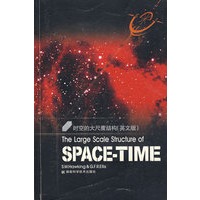
| preface 1 The role of gravity 2 Diferential geometry 2.1 Manifolds 2.2 Voctors and geomety 2.3 Maps of manifolds 2.4 Exterior differentiation and the Lie derivative 2.5 Covariant differentiation and the curvature tensor 2.6 The metric 2.7 Hypersurfaces 2.8 The volume element and Gauss' theorem 2.9 Fibre bundles 3 General Relativity 3.1 The space-time manifold 3.2 The matter fields 3.3 Lagrangian formulation 3.4 The field equations 4 The physical significance of curvature 4.1 Timelike curves 4.2 Null curves 4.3 Energy conditions 4.4 Conjugate points 4.5 Variation of arc-length 5 Exact solutions 5.1 Minkowski space-time 5.2 De Sitter and anti-de Sitter space-times 5.3 Robertson-Walker spaces 5.4 Spatially homogeneous cosmological models 5.5 The Schwarzsehild and Reissner-NordstrSm solutions 5.6 The Kerr solution 5.7 GSdel's universe 5.8 Taub-NUT space 5.9 Further exact solutions 6 Causal structure 6.10rientability 6.2 Causal curves 6.3 Achronal boundaries 6.4 Causality conditions 6.5 Cauchy developments 6.6 Global hyperbolicity 6.7 The existence of geodesics 6.8 The causal boundary of space-time 6.9 Asymptotically simple spaces 7 The Cauchy problem in General Relativity 7.1 The nature of the problem 7.2 The reduced Einstein equations 7.3 The initial data 7.4 Second order hyperbolic equations 7.5 The existence and uniqueness of developments for the empty space Einstein equations 7.6 The maximal development and stability 7.7 The Einstein equations with matter 8 Space-time singularities 8.1 The definition of singularities 8.2 Singularity theorems 8.3 The description of singularities 8.4 The character of the singularities 8.5 Imprisoned incompleteness 9 Gravitational collapse and black holes 9.1 Stellar collapse 9.2 Black holes 9.3 The final state of black holes 10 The initial singularity in teh universe Teferences Notation Index |



 内容加载中,请稍后...




商品评论(0条)