| |
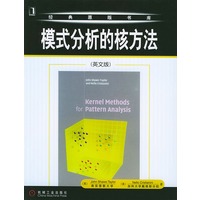
| John Shawe-Taylor英国南安普敦大学计算机科学系教授。1986年在伦敦大学皇家勒威学院获得博士学位。他的主要研究领域包括:神经网络、机器学习、信息论、算法理论、机器视觉、语言处理、触觉处理等。他还是NeuroCOLT学会欧洲组的成员,发表过大量技术论文。
Nello Cristianini美国加州大学戴维斯分校统计学系副教授。他的主要研究领域包括:机器学习算法的分析与设计及其应用领域。他还是Journal of Machine Learning Research杂志的执行编辑。 |
| List of code fragments Preface Part I Basic concepts 1 Pattern analysis 1.1 Patterns in data 1.2 Pattern analysis algorithms 1.3 Exploiting patterns 1.4 Summary 1.5 Further reading and advanced topics 2 Kernel methods: an overview 2.1 The overall picture 2.2 Linear regression in a feature space 2.3 Other examples 2.4 The modularity of kernel methods 2.5 Roadmap of the book 2.6 Summary 2.7 Further reading and advanced topics 3 Properties of kernels 3.1 Inner products and positive semi-definite matrices 3.2 Characterisation of kernels 3.3 The kernel matrix 3.4 Kernel construction 3.5 Summary 3.6 Further reading and advanced topics 4 Detecting stable patterns 4.1 Concentration inequalities 4.2 Capacity and regularisation: Rademacher theory 4.3 Pattern stability for kernel-based classes 4.4 A pragmatic approach 4.5 Summary 4.6 Further reading and advanced topics Part II Pattern analysis algorithms 5 Elementary algorithms in feature space 5.1 Means and distances 5.2 Computing projections: Gram-Schmidt, QR and Cholesky 5.3 Measuring the spread of the data 5.4 Fisher discriminant analysis I 5.5 Summary 5.6 Further reading and advanced topics 6 Pattern analysis using eigen-decompositions 6.1 Singular value decomposition 6.2 Principal components analysis 6.3 Directions of maximum covariance 6.4 The generalised eigenvector problem 6.5 Canonical correlation analysis 6.6 Fisher discriminant analysis II 6.7 Methods for linear regression 6.8 Summary 6.9 Further reading and advanced topics 7 Pattern analysis using convex optimisation 7.1 The smallest enclosing hypersphere 7.2 Support vector machines for classification 7.3 Support vector machines for regression 7.4 On-line classification and regression 7.5 Summary 7.6 Further reading and advanced topics 8 Ranking, clustering and data visualisation 8.1 Discovering rank relations 8.2 Discovering cluster structure in a feature space 8.3 Data visualisation 8.4 Summary 8.5 Further reading and advanced topics Part III Constructing kernels 9 Basic kernels and kernel types 9.1 Kernels in closed form 9.2 ANOVA kernels 9.3 Kernels from graphs 9.4 Diffusion kernels on graph nodes 9.5 Kernels on sets 9.6 Kernels on real numbers 9.7 Randomised kernels 9.8 Other kernel types 9.9 Summary 9.10 Further reading and advanced topics 10 Kernels for text 10.1 From bag of words to semantic space 10.2 Vector space kernels 10.3 Summary 10.4 Further reading and advanced topics 11 Kernels for structured data: strings, trees, etc. 11.1 Comparing strings and sequences 11.2 Spectrum kernels 11.3 All-subsequences kernels 11.4 Fixed length subsequences kernels 11.5 Gap-weighted subsequences kernels 11.6 Beyond dynamic programming: trie-based kernels 11.7 Kernels for structured data 11.8 Summary 11.9 Further reading and advanced topics 12 Kernels from generative models 12.1 P-kernels 12.2 Fisher kernels 12.3 Summary 12.4 Further reading and advanced topics Appendix A Proofs omitted from the main text Appendix B Notational conventions Appendix C List of pattern analysis methods Appendix D List of kernels References Index |



 内容加载中,请稍后...




商品评论(0条)