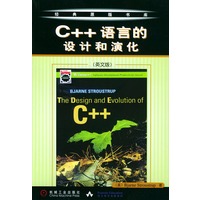
| 美国软件开发杂志获奖图书,为软件产业带来震撼与效率. |
|
|
| Preface Acknowledgments Contents Notes to the Reader Introduction How to Read this Book C++ Timeline Focus on Use and Users Programming Languages References Part I: The Prehistory of C++ 1.1 Simula and Distributed Systen1s 1.2 C and Systems Programming 1.3 General Background C with Classes 2.1 The Birth of C with Classes 2.2 Feature overview 2.3 Classes 2.4 Run-Time Efficiency 2.5 The Linkage Model 2.6 Static Type Checking 2.7 Why C? 2.8 Syntax Problems 2.9 Derived Classes 2.10 The Protection Model 2.11 Run-Time Guarantees 2.12 Minor Features 2.13 Features Considered, but not Provided 2.14 Work Environment The Birth of C++ 3.1 From C with Classes to C++ 3.2 Aims 3.3 Cfront 3.4 Language Features 3.5 Virtual Functions 3.6 Overloading 3.7 References 3.8 Constants 3.9 Memory Management 3.10 Type Checking 3.11 Minor Peatures 3.12 Relationship to Classic C 3.13 Tools for Language Design 3.14 The C++ Programming Language (lst edition) 3.15 The Whatis? Paper C++ Language Design Rules 4.1 Rules and Principles 4.2 General Ru1es 4.3 Design Support Rules 4.4 Language-Technical Rules 4.5 Low-Level Programming Support Rules 4.6 A Final Word Chronology 1985-1993 5.1 Introduction 5.2 Release 2.0 5.3 The Annotated Reference Manual 5.4 ANSI and ISO Standardization Standardization Interest and Use Libraries Looking Ahead Part II: Memory Management Overloading Multiple Inheritance Class Concept Rennements Casting Templater Exception Handling Namespaces The C Preprocessor 18.1 Cpp Index |

 内容加载中,请稍后...




商品评论(0条)