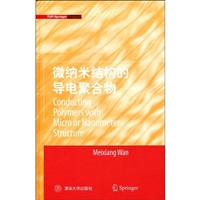
| 《微纳米结构的导电聚合物》由清华大学出版社出版。 Conducting Polymers with Micro or Nanometer Structure describes a topicdiscovered by three winners of the Nobel Prize in Chemistry in 2000: AlanJ. Heeger, University of California at Santa Barbara, Alan G. MacDiarmid atthe University of Pennsylvania, and Hideki Shirakawa at the University ofTsukuba. Since then, the unique properties of conducting polymers have ledto promising applications in functional materials and technologies. The bookfirst briefly summarizes the main concepts of conducting polymers beforeintroducing micro/nanostructured conducting polymers dealing with theirsynthesis, structural characterizations, formation mechanisms, physical and chemical properties, and potential applications in nanomaterials andnanotechnology. The book is intended for researchers in the related fieldsof chemistry, physics, materials, nanomaterials and nanodevices. MeixiangWan is a professor at the Institute .of Chemistry, Chinese Academy ofSciences, Beijing. |
Chapter I Introduction of Conducting Polymers 1.1 Discovery of Conducting Polymers 1.2 Structural Characteristics and Doping Concept 1.3 Charge Carriers and Conducting Mechanism References Chapter 2 Polyaniline as A Promising Conducting Polymer 2.1 Molecular Structure and Proton Doping 2.2 Synthesis Method 2.2.1 Chemical Method 2.2.2 Electro-Chemical Method 2.2.3 Mechano-Chemical Route 2.3 Physical Properties . 2.3.1 Nonlinear Optical (NLO) 2.3.2 Electrical and Charge Transport Properties 2.3.3 Magnetic Properties 2.3.4 Other Properties 2.4 Solubility and Processability 2.4.1 Solubility 2.4.2 Processability References Chapter 3 Physical Properties and Associated Applications of Conducting Polymers 3.1 Electronic Devices 3.1.1 Light Emitting Diodes (LEDs) 3.1.2 Solar Cells 3.2 EMI Shielding and Microwave Absorbing Materials 3.2.1 EMI Shielding Materials 3.2.2 Microwave Absorption Materials (Stealth Materials) 3.3 Rechargeable Batteries and Supercapacitors 3.3.1 Rechargeable Batteries 3.3.2 Supercapacitors 3.4 Sensors 3.5 Electrochromic Devices and Artificial Muscles 3.5.1 Electrochromic Devices 3.5.2 Conducting Polymer-Based Artificial Muscles 3.6 Others 3.6.1 Corrosion Materials 3.6.2 Electrostatic Dissipation Materials 3.6.3 Separated Membrane 3.6.4 Conducting Textiles References Chapter 4 Conducting Polymer Nanostructures 4.1 Synthetic Method and Formation Mechanism 4.1.1 Hard Template Method 4.1.2 Soft Template Method 4.1.3 Other Methods 4.1.4 PEDOT Nanostructures 4.2 Composite Nanostructures 4.2.1 Metal-Conducting Polymer Composite Nanostructures 4.2.2 Conducting Polymer/Carbon Nanotube Composites 4.2.3 Core-Shell Composites 4.2.4 Chiral and Biological Composite Nanostructures 4.2.5 Inorganic Oxide Nano-Crystals and CP Composites 4.3 Physical Properties and Potential Application 4.3.1 Electrical and Transport Properties 4.3.2 Potential Applications 4.3.3 Nano-arrays or Nano-patents References Chapter 5 Template-Free Method to Conducting Polymer MicrofNanostructures 5.1 Template-Free Method 5.1.1 Discovery of Template-Free Method 5.1.2 Universality of Template-Free Method 5.1.3 Controllability of Morphology and Diameter by Template-Free Method 5.1.4 Self-Assembly Mechanism of Micro/Nanostructures by A Template-Free Method 5.2 Multi-Functionality of Micro/Nanostmctures Based on Template-Free Method 5.2.1 Processing Composite Nanostructures 5.2.2 PPy-CNT Composite Nanostructures 5.2.3 Electro-Magnetic Functional Micro/Nanostructures 5.2.4 Electro-Optic Micro/Nanostructures 5.2.5 Super-Hydrophobic 3D-Microstructures Assembled from 1D-Nanofibers 5.3 Mono-Dispersed and Oriented Micro/Nanostructures 5.3. I Template-Free Method Combined with A1203 Template for Oriented Nanowires 5.3.2 Template-Free Method Associated with A Deposition to Mono-Dispersed and Oriented Microspheres 5.4 Electrical and Transport Properties of Conducting Polymer Nanostructures 5.4.1 Room Temperature Conductivity 5.4.2 Temperature Dependence of Conductivity 5.4.3 Electrical Properties of A Single Micro/Nanostructure 5.4.4 Magneto-Resistance 5.5 Special Methods for Micro/Nanostructures of Conducting Polymers 5.5.1 Aniline/Citric Acid Salts as The "Hard-Templates" for Brain-like Nanostructures 5.5.2 Cu20 Crystal as A Hard Template 5.5.3 Water-Assisted Fabrication of PANI-DBSA Honeycomb Structure 5.5.4 Reversed Micro-Emulsion Polymerization 5.6 Potential Applications of Conducting Polymer with Micro/Nanostructures 5.6.1 Microwave Absorbing Materials 5.6.2 EMI Shielding Materials 5.6.3 Conducting Polymer Nanostructure-Based Sensors Guided by Reversible Wettability References Appendix Term Definitions |
 内容加载中,请稍后...








商品评论(0条)