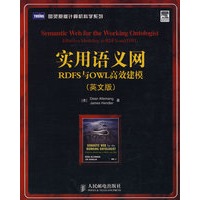
| 由Web之父TimJohnBertlers-Lee提出的语义网标志着又一场革命,它要大大提升万维网,为其内容添加语义,使其成为人们与计算机系统共享数据、信息和知识的更为强大的通用媒介。随着Web2.O和云计算等概念的不断深入人心。语义网的思想和技术已经逐渐融入到各种主流的软件(如Oracle、Photostlop)和Web应用(如社区网站、搜索)中。 但是,长期以来,语义网方面的资料严重缺乏,除了标准规范本身之外,相关的图书基本上只是触及皮毛,缺乏实战指导。《实用语义网RDFS与OWL高效建模》填补了这一空白。它由两位语义网世界级权威合作撰写。已经成为此领域不可或缺的权威著作。书中针对程序员和领域专家。在透彻而详细地讲述了语义网及其核心技术(RDFS和OW[.)的基础知识之后。提供了大量解决实际问题的方案、实例、技巧和经验。阅读《实用语义网RDFS与OWL高效建模》之后,读者可以大大加深对语义网的理解。充满自信地面对今天和未来的技术挑战。 “本书正是我这些年一直期待的,它的出版将帮助更多人真正理解语义网。我相信它对于语义网社区的作用,就像《Java编程思想》之于Java社区。” ——HenryStory,Sun公司语义网专家 “本书的两位作者都是语义网的权威,一个来自学界,一个来自业界,堪称完美组合。他们使原本晦涩难懂的语义网和相关的知识表示标准变得生动易懂。强烈推荐。” ——MarkA.Musen,斯坦福大学教授,著名开源语义网平台Prot6g6项目负责人 “Hendler和Allemang的这本书正是我们一直在寻找的。以前的同类图书对做实际工作的人帮助甚微,而这本书可读性很强,例子丰富而且简单易懂。我推荐大家都去买这本书。” ——DavidMcComb |
| Dean Allemang,世界知名的语义网专家。英国剑桥大学数学专业硕士,美国俄亥俄州立大学计算机专业博士。有丰富的语义网开发经验,曾创办了最早的一家语义网技术公司,目前担任美国领先的语义网技术公司TopQLladrant的首席科学家。JoumalofWebSemantics编委。世界最大的语义网研究机构DigitalEnterprise研究院的评审委员会成员。自2003年起一直担任国际语义网会议工业应用方向的主席。 James Hendler,语义网的创始人之一,万维网联盟语义网协调组成员。美国人工智能协会和英国计算机协会会士。曾任美国国防部高级研究计划局(DARPA)的信息系统办公室首席科学家。目前是Rensselaer理工学院教授,并兼任麻省理工学院Web科学研究项目的副主任。他还是IEEEIntelligentSystems的主编,也是第一位担任美国《科学》杂志评审委员的计算机科学家。 |
| CHAPTER 1 What Is the Semantic Web? What Is a Web? Smart Web, Dumb Web Smart Web Applications A Connected Web Is a Smarter Web Semantic Data A Distributed Web of Data Features of a Semantic Web What about the Round-Worlders? To Each Their Own There's Always One More Summary Fundamental Concepts CHAPTER 2 Semantic Modeling Modeling for Human Communication Explanation and Prediction Mediating Variability Variation and Classes Variation and Layers Expressivity in Modeling Summary Fundamental Concepts CHAPTER 3 RDF--The Basis of the Semantic Web Distributing Data Across the Web Merging Data from Multiple Sources Namespaces, URIs, and Identity Expressing URIs in Print Standard Namespaces Identifiers in the RDF Namespace Challenge- RDF and Tabular Data Higher-Order Relationships Alternatives for Serialization N-Triples Notation 3 RDF (N3) RDF/XML Blank Nodes Ordered Information in RDF Summary Fundamental Concepts CHAPTER 4 Semantic Web Application Architecture RDF Parser/Serializer Other Data Sources--Converters and Scrapers RDF Store RDF Data Standards and Interoperability of RDF Stores RDF Query Engines and SPARQL Comparison to Relational Queries Application Code RDF-Backed Web Portals Data Federation Summary Fundamental Concepts CHAPTER 5 RDF and Inferencing Inference in the Semantic Web Virtues of hfference-Based Semantics Where are the Smarts? Asserted Triples versus Inferred Triples When Does Inferencing Happen? Inferencing as Glue Summary Fundamental Concepts CHAPTER 6 RDF Schema Schema Languages and Their Functions What Does It Mean? Semantics as Inference The RDF Schema Language Relationship Propagation through rdfs:subPropertyOf Typing Data by Usage--rdfs:domain and rdfs:range Combination of Domain and Range with rdfs:subClassOf RDFS Modeling Combinations and Patterns Set Intersection Property Intersection Set Union Property Union Property Transfer Challenges Term Reconciliation Instance-Level Data Integration Readable Labels with rdfs:label Data Typing Based on Use Filtering Undefined Data RDFS and Knowledge Discovery Modeling with Domains and Ranges Multiple Domains/Ranges Nonmodeling Properties in RDFS Cross-Referencing Files: rdfs:seeAlso Organizing Vocabularies: rdfs:isDefmedBy Model Documentation: rdfs:comment Summary Fundamental Concepts CHAPTER RDFS-Plus Inverse Challenge: Integrating Data that Do Not Want to Be Integrated Challenge: Using the Modeling Language to Extend the Modeling Language Challenge: The Marriage of Shakespeare Symmetric Properties Using OWL to Extend OWL Transitivity Challenge: Relating Parents to Ancestors Challenge: Layers of Relationships Managing Networks of Dependencies Equivalence Equivalent Classes Equivalent Properties Same Individuals Challenge: Merging Data from Different Databases Computing Sameness--Functional Properties Functional Properties Inverse Functional Properties Combining Functional and Inverse Functional Properties A Few More Constructs Summary Fundamental Concepts CHAPTER 8 Using RDFS-Plus in the Wild SKOS Semantic Relations in SKOS Meaning of Semantic Relations Special Purpose Inference Published Subject Indicators SKOS in Action FOAF People and Agents Names in FOAF Nicknames and Online Namds Online Persona Groups of People Things People Make and Do Identity in FOAF It's Not What You Know, It's Who You Know Summary Fundamental Concepts CHAPTER 9 Basic OWL Restrictions Example: Questions and Answers Adding "Restrictions" Kinds of Restrictions Challenge Problems Challenge: Local Restriction of Ranges Challenge: Filtering Data Based on Explicit Type Challenge: Relationship Transfer in SKOS Relationship Transfer in FOAF Alternative Descriptions of Restrictions Summary Fundamental Concepts CHAPTER 10 Counting and Sets in OWL Unions and Intersections Closing the World Enumerating Sets with owL'oneOf Differentiating Individuals with owl:differentFrom Differentiating Multiple Individuals Cardinality Small Cardinality Limits Set Complement Disjoint Sets Prerequisites Revisited No Prerequisites Counting Prerequisites Guarantees of Existence Contradictions Unsatisfiable Classes Propagation of Unsatisfiable Classes Inferring Class Relationships Reasoning with Individuals and with Classes Summary Fundamental Concepts CHAPTER 11 Using OWL in the Wild The Federal Enterprise Architecture Reference Model Ontology Reference Models and Composability Resolving Ambiguity in the Model: Sets versus Individuals Constraints between Models OWL and Composition owl:Ontology owl:imports Advantages of the Modeling Approach The National Cancer Institute Ontology Requirements of the NCI Ontology Upper-Level Classes Describing Classes in the NCI Ontology Instance-Level Inferencing in the NCI Ontology Summary Fundamental Concepts CHAPTER 12 Good and Bad Modeling Practices Getting Started Know What You Want Inference Is Key Modeling for Reuse Insightful Names versus Wishful Names Keeping Track of Classes and Individuals Model Testing Common Modeling Errors Rampant Classism (Antipattern) Exclusivity (Antipattern) Objectification (Antipattern) Managing Identifiers for Classes (Antipattern) Creeping Conceptualization (Antipattern) Summary Fundamental Concepts CHAPTER 13 OWL Levels and Logic OWL Dialects and Modeling Philosophy Provable Models Executable Models OWL Full versus OWL DL Class/Individual Separation InverseFunctional Datatypes OWL Lite Other Subsets of OWL Beyond OWL 1.0 Metamodeling Multipart Properties Qualified Cardinality Multiple Inverse Functional Properties Rules Summary Fundamental Concepts CHAPTER 14 Conclusions APPENDIX Frequently Asked Questions Further Reading Index |
 内容加载中,请稍后...








商品评论(0条)