|
|
|
|
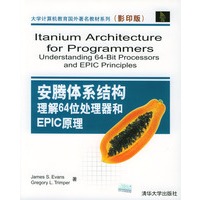
| List of Figures List of Tables Preface Acknowledgments Trademarks Chapter 1 Architecture and Implementation 1.1 Analogy:Piano Architecture 1.2 Types of Computer Languages 1.3 Why Study Assembly Language? 1.4 Prefixes for Binary Multiples 1.5 Instruction Set Architectures 1.6 The Life Cycle of Computer Architectures 1.7 SQUARES:A First Programming Example 1.8 Review of Number Systems Chapter 2 Computer Structures and Data Representations 2.1 Computer Structures 2.2 Instruction Execution 2.3 Classes of Instruction Set Architectures 2.4 Migration to 64-Bit Architectures 2.5 Itanium Information Units and Data Types Chapter 3 The Program Assembler and Debugger 3.1 Programming Environments 3.2 Program Development Steps 3.3 Comparing Variants of a Source File 3.4 Assembler Statement Types 3.5 The Functions of a Symbolic Assembler 3.6 The Assembly Process 3.7 The Linking Process 3.8 The Program Debugger 3.9 Conventions for Writing Programs Chapter 4 Itanium Instruction Formats and Addressing 4.1 Overview of Itanium Instruction Formats 4.2 Integer Arithmetic Instructions 4.3 Bit Encoding for Itanium Instructions 4.4 HEXNUM:Using Arithmetic Instructions 4.5 Data Access Instructions 4.6 Other ALU Instructions 4.7 DOTPROD:Using Data Access Instructions 4.8 Itanium Addressing Modes 4.9 Addressing in Other Architectures Chapter 5 Comparison,Branches,and Predication 5.1 Hardware Basis for Control Flow 5.2 Integer Compare Instructions 5.3 Program Branching 5.4 DOTLOOP:Using a Counted Loop 5.5 Stops,Instruction Groups,and Performance 5.6 DOTCLOOP:Using the Loop Count Register 5.7 Other Structured Programming Constructs 5.8 MAXIMUM:Using Conditional Instructions Chapter 6 Logical Operations,Bit-Shifts,and Bytes 6.1 Logical Functions 6.2 HEXNUM2:Using Logical Masks 6.3 Bit and Field Operations 6.4 SCANTEXT:Processing Bytes 6.5 Integer Multiplication and Division 6.6 DECNUM:Converting an Integer to Decimal Format 6.7 Using C for SCII Input and Output 6.8 BACKWARD:Using Byte Manipulations Chapter 7 Subroutines,Procedures,and Functions 7.1 Memory Stacks 7.2 DECNUM2:Using Stack Operations 7.3 Register Stacks 7.4 Program Segmentation 7.5 Calling Conventions 7.6 DECNUM3 and BOOTH:Making a Function 7.7 Integer Quotients and Remainders 7.8 RANDOM:A Callable Function Chapter 8 Floating-Point Operations 8.1 Parallels Between Integer and Floating-Point Instructions 8.2 Representations of Floating-Point Values 8.3 Copying Floating-Point Data 8.4 Floating-Point Arithmetic Instructions 8.5 HORNER:Evaluating a Polynomial 8.6 Predication Based on Floating-Point Values 8.7 Integer Operations in Floating-Point Execution Units 8.8 Approximations for Reciprocals and Square Roots 8.9 APPROXPI:Using Floating-Point Instructions Chapter 9 Input and Output of Text 9.1 File Systems 9.2 Keyboard and Display I/O 9.3 SCANTERM:Using C Standard I/O 9.4 SORTSTR:Sorting Strings 9.5 Text File I/O 9.6 SCANFILE:Input and Output with Files 9.7 SORTINT:Sorting Integers from a File 9.8 Binary Files Chapter 10 Performance Considerations 10.1 Processor-Level Parallelism 10.2 Instruction-Level Parallelism 10.3 Explicit Parallelism in the Itanium Processors 10.4 Software-Pipelined Loops 10.5 Modulo Scheduling a Loop 10.6 Program Optimization Factors 10.7 Fibonacci Numbers Chapter 11 Looking at Output from Compilers 11.1 Compilers for RISC-like Systems 11.2 Compiling a Simple Program 11.3 Optimizing a Simple Program 11.4 Inline Optimizations 11.5 Profile-Guided or Other Optimizations 11.6 Debugging Optimized Programs 11.7 Recursion for Fibonacci Numbers Revisited Chapter 12 Parallel Operations 12.1 Classification of Computing Systems 12.2 Integer Parallel Operations 12.3 Applications to Integer Multiplication 12.4 Opportunities and Challenges 12.5 Floating-Point Parallel Operations 12.6 Semaphore Support for Parallel Processes Chapter 13 Variations Among Implementations 13.1 Why Implementations Change 13.2 How Implementations Change 13.3 The Original Itanium Processor 13.4 A Major Role for Software 13.5 IA-32 Instruction Set Mode 13.6 Determining Extensions and Implementation Version Appenix A Command-Line Environments References Exercises Appenix B Suggested System Resources B.1 System Hardware B.2 System Software B.3 Desktop Client Access Software Appendix C Itanium Instruction Set C-1 Instructions Listed by Function C-2 Instructions Listed by Assembler Opcode References Appendix D Itanium Registers and Their Uses D.1 Instruction Pointer D.2 General Registers and NaT Bits D.3 Predicate Registers D.4 Branch Registers D.5 Floating-Point Registers D.6 Application Registers D.7 State Management Registers D.8 System Information Registers D.9 System Control Registers References Appendix E Conditional Assembly and Macros(GCC Assembler) E.1 Interference from Explicit Stops E.2 Repeat Blocks E.3 Conditional Assembly E.4 Macro Processing E.5 Using Labels with Macros E.6 Recursive Macros E.7 Object File Sections E.8 MONEY:A Macro Illustrating Sections Appendix F Inline Assembly F.1 HP-UX C Compilers F.2 GCC Compiler for Linux F.3 Intel Compilers for Linux References Bibliography Answers and Hints for Selected Exercises Chapter 1 Chapter 2 Chapter 3 Chapter 4 Chapter 5 Chapter 6 Chapter 7 Chapter 8 Chapter 9 Chapter 10 Chapter 11 Chapter 12 Chapter 13 About the Authors Index |
![Microchip PIC系列单片机原理、应用与开发[按需印刷]](http://images.china-pub.com/ebook15001-20000/15432/zcover.jpg)


 内容加载中,请稍后...




商品评论(0条)