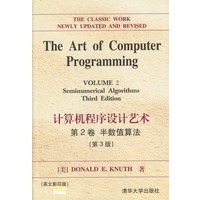
| 如果你是一名真正优秀的程序员……读Knuth的《计算机程序设计艺术》。如果你读懂整套书,请给我发一份简历。
——Bill Gates 这部多卷专著是公认的对经典计算机科学最权威的描述。几十年来,无论是学生、研究人员还是编程从业人员,本套书的前三卷都是他们学习编程理论、进行编程实践的宝贵资源。 这是一套集所有基础算法之大成的经典之作,当今软件开发人员所掌握的绝大多数计算机程序设计的知识都来源于此。 ——Byte |
| Donald.E.Knuth(唐纳德.E.克努特,中文名高德纳)是算法和程序设计技术的先驱者,是计算机排版系统TEX和METAFONT的发明者,他因这些成就和大量创造性的影响深远的著作(19部书和160篇论文)而誉满全球。作为斯坦福大学计算机程序设计艺术的荣誉退休教授,他当前正全神贯注于完成其关于计算机科学的史诗性的七卷集。这一伟大工程在1962年他还是加利福尼亚理工学院的研究生时就开始了。Knuth教授获得了许多奖项和荣誉,包括美国计算机协会图灵奖(ACM Turing Award),美国前总统卡特授予的科学金奖(Medal of Science),美国数学学会斯蒂尔奖(AMS Steele Prize),以及1996年11月由于发明先进技术而荣获的备受推崇的京都奖(Kyoto Prize)。Knuth教授现与其妻Jill生活于斯坦福校园内。
访问Knuth教授的个人主页,可以获得有关本书及本系列其他未出版图书的更多信息: www-cs-faculty.stanford.edu/~knuth |
| Chapter 1 Basic Concepts 1.1. Algorithms 1.2. Mathematical Preliminaries 1.2.1. Mathematical Induction 1.2.2. Numbers, Powers, and Logarithms 1.2.3. Sums and Products 1.2.4. Integer Functions and Elementary Number Theory 1.2.5. Permutations and Factorials 1.2.6. Binomial Coefficients 1.2.7. Harmonic Numbers 1.2.8. Fibonacci Numbers 1.2.9. Generating Functions 1.2.10. Analysis of an Algorithm *1.2.11. Asymptotic Representations *1.2.11.1. The O-notation *1.2.11.2. Euler's summation formula *1.2.11.3. Some asymptotic calculations 1.3. MIX 124 1.3.1. Description of MIX 1.3.2. The MIX Assembly Language 1.3.3. Applications to Permutations 1.4. Some Fundamental Programming Techniques 1.4.1. Subroutines 1.4.2. Goroutines 1.4.3. Interpretive Routines 1.4.3.1. A MIX simulator *1.4.3.2. Trace routines 1.4.4. Input and Output 1.4.5. History and Bibliography Chapter 2 Information Structures 2.1. Introduction 2.2. Linear Lists 2.2.1. Stacks, Queues, and Deques 2.2.2. Sequential Allocation 2.2.3. Linked Allocation 2.2.4. Circular Lists 2.2.5. Doubly Linked Lists 2 2.6. Arrays and Orthogonal Lists 2.3. Trees 2.3.1. Traversing Binary Trees 2.3.2. Binary Tree Representation of Trees 2.3.3. Other Representations of Trees 2.3.4. Basic Mathematical Properties of Trees 2.3.4.1. Free trees 2.3.4.2. Oriented trees *2.3.4.3. The "infinity lemma" *2.3.4.4. Enumeration of trees 2.3.4.5. Path length *2.3.4.6. History and bibliography 2.3.5. Lists and Garbage Collection 2.4. Multilinked Structures 2.5. Dynamic Storage Allocation History and Bibliography Answers to Exercises Appendix A Tables of Numerical Quantities 1. Fundamental Constants (decimal) 2. Fundamental Constants (octal) 3. Harmonic Numbers, Bernoulli Numbers, Fibonacci Numbers Appendix B Index to Notations Index and Glossary Excerpt Chapter 3 Random Numbers. Introduction. Generating Uniform Random Numbers. The Linear Congruential Method. Other Methods. Statistical Tests. General Test Procedures for Studying Random Data. Empirical Tests. Theoretical Tests. The Spectral Test. Other Types of Random Quantities. Numerical Distributions. Random Sampling and Shuffling. What Is a Random Sequence? Summary. Chapter 4 Arithmetic. Positional Number Systems. Floating Point Arithmetic. Single-Precision Calculations. Accuracy of Floating Point Arithmetic. Double-Precision Calculations. Distribution of Floating Point Numbers. Multiple Precision Arithmetic. The Classical Algorithms. Modular Arithmetic. How Fast Can We Multiply?. Radix Conversion. Rational Arithmetic. Fractions. The Greatest Common Divisor. Analysis of Euclid's Algorithm. Factoring into Primes. Polynomial Arithmetic. Division of Polynomials. Factorization of Polynomials. Evaluation of Powers. Evaluation of Polynomials. Manipulation of Power Series. Answers to Exercises. Appendix A: Tables of Numerical Quantities. Fundamental Constants (decimal). Fundamental Constants (octal). Harmonic Numbers, Bernoulli Numbers, Fibonacci Numbers. Appendix B: Index to Notations. Index and Glossary. Chapter 5 Sorting. Combinatorial Properties of Permutations. Inversions. Permutations of a Multiset. Runs. Tableaux and Involutions. Internal sorting. Sorting by Insertion. Sorting by Exchanging. Sorting by Selection. Sorting by Merging. Sorting by Distribution. Optimum Sorting. Minimum-Comparison Sorting. Minimum-Comparison Merging. Minimum-Comparison Selection. Networks for Sorting. External Sorting. Multiway Merging and Replacement Selection. The Polyphase Merge. The Cascade Merge. Reading Tape Backwards. The Oscillating Sort. Practical Considerations for Tape Merging. External Radix Sorting. Two-Tape Sorting. Disks and Drums. Summary, History, and Bibliography. Chapter 6 Searching. Sequential Searching. Searching by Comparison of Keys. Searching an Ordered Table. Binary Tree Searching. Balanced Trees. Multiway Trees. Digital Searching. Hashing. Retrieval on Secondary Keys. Answers to Exercises. Appendix A: Tables of Numerical Quantities. Fundamental Constants (decimal). Fundamental Constants (octal). Harmonic Numbers, Bernoulli Numbers, Fibonacci Numbers. Appendix B:Index to Notations. Index and Glossary. |

 内容加载中,请稍后...




商品评论(0条)