最 低 价:¥29.20

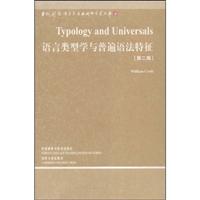
| 与第一版相比,《语言类型学与普遍语法特征(第2版)》在章节编排上多有调整,特别是增加了类型学研究的最新成果:语义地图模型,作者也从这个角度对旧版内容重新加以审视。 |
| William Croft:曼彻斯特大学语言学教授。 |
| List offigures List of tables Preface to the second edilion preface to the timedition List ofabbreviations List ofsymbols 1 Introduction 1.1 Whatistypology? 1.2 Typology,universals and generative grammar 1.3 Cross-linguistic comparison 1.4 The problem ofcross linguistic comparability 1.5 Language sampling for cross-linguistic research 1.6 Data sources 2 Typologicai classification 2.1 A cross-linguistically valid description of morphosyntactic structures 2.1.1 Simple strategies 2.1.2 Relational strategies 2.1.3 Indexical strategies 2.1.4 Classifiers:indexical or relational? 2.1.5 More grammaticalized strategies 2.1.6 Summary 2.2 What is being classified? 2.3 M0rphological typology 3 Implicational universals and competing motivations 3.1 Restrictions on possible language types 3.2 Unres~~~~Cted and implicational universals 3.3 Competing motivations 3.4 Deeperexplanationsforwordorder and affixorderuniversals 3.5 Typology。universals and generative grammar revisited 3 6Conclusion 4 Grammatical categories:typological markedness economy and iconicity 4.1 Typological markedness 4.1.1 Structural coding 4.1.2 Behavioral potential 4.1.3 Neutral value:not a criterion for typological markedness 4.2 Economy and iconicity 4.2.1 Structural coding,economy and syntagmatic isomorphism 4.2.2 Economy.paradigmatic isomorphism and polysemy 4.3 Frequency and deeper explanations for economy and iconicity 4.4 Typological asymmetries in word order and phonology 4.5 Conclusion 5 Grammatical hierarchies and the semantic map model 5.1 Grammatical hierarchies and implicational universals 5.2 The animacy and definiteness hierarchies 5.3 A deeper explanation tbr hierarchies and categories:the semantic map model 5.4 Conceptual spaces.structural coding and behavioral potential 5.5 111e grammatical relations hierarchies 5.5.1 The external definition of grammatical relations 5.5.2 Subject and object,ergative and absolutive 5.5.3 Objects:direct and indirect.primary and secondary 5.5.4 T11e conceptual space for grammatical relations 5.6 Conclusion Appendix:typological markedness patterns in grammatical categories 6 Prototypes and the interaction of typological patterns 6.1 Interactions ofcategories 6.1.1 Place of articulation 6.1.2 Person 6.2 Interactions of values:typological prototypes 6.3 GrammaticaI relations 6.3.1 Animacy,definiteness and participant roles 6.3.2 Transitivity 6.3.3 Deeper explanations for the typology of grammatical relations 6.4 Parts ofspeech 6.5 Other prototypes and markedness reversals 6 6 Conclusion 7 Syntactic argumentation and syntactic structure in typology 7.1 Typology and syntactic argumentation 7.2 lconicity,economy and syntactic structure 7.2.1 Conceptual distance and constituent structure 7.2 2 Syntactic and conceptual independence 7.2.3 The encoding of objects and events 7.2.4 Other universals of linguistic structure 7.3 Vypological conspiracies and communicative motivation 7.4 Conclusion 8 Diachronic typology 8.1 The dynamicization of synchronic typology 8.2 From states to processes 8.3 Grammaticalization 8.3.1 Phonological processes 8.3.2 Morphosyntactic processes 8.3.3 Functional processes 8.3.4 Issues in grammaticalization 8.3.5 Explanations for grammaticalization 8.4 Inferring diachrony from synchrony 8.5 Conclusion 9 Typology as an approach to language 9.1 Scientific approaches(research traditions)and linguistic theories 9.2 Thinking like a typologist 9.3 Description.explanation and generalization 9.4 Typology,the Saussurean dichotomies and the evolutionary model List of references Map oflanguages cited Author index Language index Subiect index |


 内容加载中,请稍后...




商品评论(0条)