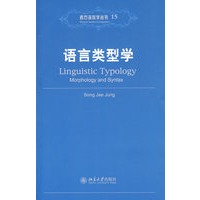
| 对于研究兴趣在语言类型和语言共性、语言比较、历时语言学、语言习得、语言认知等领域的读者而言,《语言类型学》都是一部有价值的著作。 |
| 给中国读者的前言 Preface 导读 Abbreviario Acknowledgements 1 Introducing linguistic typology 1.1 What do linguistic typologists study? 1.2 Typological analysis 13 Typology of language universals 1.4 Language universals and linguistic typology 1.5 Assumptions and problems in typological analysis 1.5.1 Cross-linguistic comparability 1.5.2 The Principle of Uniformitarianism 1.5.3 Approaches to language sampling 1.5.4 Determining language sample sizes 1.5.5 Problems with data 1.6 Partial typology VS.holistic typology 1.7 Organization ofthe rest ofthe book 2 Basic WOrd Order 2.1What is basic word order? 2.2 Early research on basic word order 2.2.1 The inception of word order typology 2.2.2 The OV-VO typology 2.2.3 Making language universals exceptionless 2.3 Explaining the distribution of the basic clausal word orders 2.4 Back to the OV-VO typology:the Branching Direction Theory 2.5 Seeking a global explanation:the Early Immediate Constituents Theory 2.6 From word order to morpheme order:the suffixing preference 2.7 Closing remarks 3 Case marking 3.1 Introduction 3.2 AS and P, and types of case marking 3.2.1 Nominative-accusative system 3.2.2 Ergative-absolutive system 3.2.3 Tripartite system 3.2.4 AP/S system 3.2.5 Neutral system 3.3 More types of case marking 3.3.1 Split-ergative system 3.3.2 Active-stative system 3.3.3 Direct-inverse system 3.4 Distribution of the case marking systems 3.5 The discriminatory view of case marking 3.6 The indexing view of case marking 3.7 The discriminatory view vs. the indexing view 3.8 The Nominal Hierarchy and the split-ergative system 3.9 Towards a unified explanation: attention flow and viewpoint 3.10 Ergativity from discourse to grammar 3.11 Case marking in altered or non-basic constructions 3.11.1 Passive 3.11.2 Antipassive 3.11.3 Noun incorporation 3.11.4 Advancement of obliques to P 3.12 Syntactic ergativity 3.13 Head marking vs. dependent marking 3.14 Case marking type and word order type 4 Relative clauses 4.1 Introduction 4.2 The position of the head noun vis-a-vis the restricting clause 4.3 Expression of the head noun 4.3.1 The obliteration strategy 4.3.2 The pronoun-retention strategy 4.3.3 The relative-pronoun strategy 4.3.4 Language-internal distribution of the relativization strategies 4.4 Accessibility Hierarchy: accessibility to relativization 4.5 Conspiracy in relativization 4.6 Correlations between RC-related properties 4.7 The head noun in the main clause 4.8 Subject primacy vs. discourse preferences in relativization 4.9 RC type and word order type 4.10 The role of processing in the distribution of RC types 4.11 The All and structural complexity 5 Causatives 5.1 Introduction 5.2 The morphologically based typology of causative constructions 5.3 The syntax of the causee NP: the Case Hierarchy 5.4 Conspiracy in causativization 5.5 Doubling: coding vs. grammatical relation 5.6 Causation types and causative types 5.7 The case marking of the causee NP 5.8 The conceptual integration of the causee in the causative event 5.9 Towards a typology of causative constructions 6 The application of linguistic typology 6.1 Introduction 6.2 Linguistic typology and historical linguistics 6.2.1 Early attempts at word order reconstruction 6.2.2 Linguistic typology as a control on, and a tool in,reconstruction 6.2.3 Linguistic typology and linguistic prehistory 6.3 Linguistic typology and language acquisition 6.3.1 Accessibility to relativization in FLA 6.3.2 Accessibility to relativization in SLA 6.3.3 Two potential FLA/SLA areas of application 6.3.4 Closing remarks 7 European approaches to linguistic typology 7.1 Introduction 7.2 The Leningrad Typology Group 7.3 The Cologne UNITYP Group 7.4 The Prague School Typology 7.5 Epilogue Bibliography Author Index Language Index Subject Index |


 内容加载中,请稍后...






商品评论(0条)