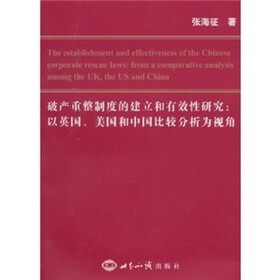
| 本书以法人拯救(Corporate Rescue, 也被称为”公司重整”)制度为题,在中美英三国之间做比较法研究,目的是找出三国在法人拯救制度立法上的异同并进而查明隐藏在不同的规则背后的立法理念和法律政策的差异。本书旨在通过比较,找出中国新的重整制度中存在问题和缺陷,以及立法外的其他导致重整制度不能在我国有效实施的因素,以英美法为镜子,提出可能的解决方案和对未来可能的发展趋势做出预测。 |
| 张海征,2004年毕业于中国政法大学国际法学院,获法学学士学位;2005年9月毕业于英国莱特斯大学法学院,获法学硕士学位;2008年10月毕业于英国菜特斯大学法学院,获法学博士学位;2008年10月至2008年12月在英国诺丁汉特伦特大学法学院担任客座讲师;2009年5月至今在北京外国语大学法学院任教,主讲商法、比较公司法和破产法。 |
| Part OneIntroduction I.Research aims and the need for this analysis II.Research methodology A.Is it appropriate to carry out a comparative research on the topic of corporate rescue? B.Main features of research objects Concluding remarks Part TwoTheoretical and functional issues of corporate rescue Introduction I.Identification of two fundamental concepts central to corporate rescue A.Property rights B.Corporate failure II.Basic theory of corporate rescue A.Definition and ideology B.Crucial elements to a corporate rescue activity III.Functional transformation of corporate insolvency law A.Historical evolution of rescue-oriented mechanisms B.Origin and development of modern corporate rescue culture Concluding remarks Part ThreeIdentifying the contextual factors and historical development of the UK, the US and China46 Introduction I.Different cultures and ideologies A.Legal cultures and ideologies regarding the role of law B.Entrepreneurial cultures and ideologies II.Historical developments of bankruptcy and corporate rescue laws in England, America and China A.England:consistent reforms towards a modern rescue culture in the past three decades B.America:formulation of the most influential corporate rescue scheme in the world-Chapter 11 C.China:long march towards an entirely new bankruptcy and corporate rescue system Concluding remarks Part FourA critical assessment of the Chinese corporate rescue laws and policies on the basis of the English and American models Introduction I.England : company voluntary arrangements (CVAs) and administration A.CVAs B.Administration proceedings II.America : Chapter 11 Reorganization A.An overview of the US Chapter 11 B.Detailed procedure C.Main reforms III.China: the modified reorganization procedure A.Initiation of the proceedings B.Moratorium C.Administrator's roles in reorganization D.Creditors' meeting and creditors' committee E.Reorganization proposal: voting, approval and implementation F.Corporate control and management in reorganization: PIP or DIP? G.A notable feature of China' s reorganization: shareholders' rights of involvement in the rescue process H.Court' s involvement I.Potential problems, solutions and prospects Concliading remarks Part FiveBalance of power and control of each interested group in the network of rescuing companies Introduction I.Banks and secured financiers A.In England B.The Chinese banking sector :in bankruptcy legal framework-improving a weak position II.Creditors in the weak bargaining position A.In England B.Inadequate protection to the weak interested groups in China III.Directors A.Regulating directors by sticks and carrots approach in England and America B.Directors in China' s two-tie1 board system: how to generate the right incentives? IV.Labour A.In England B.The labour' s position in: China' s bankruptcy legal framework V.State A.In England B.Strong position of the state in China' s bankruptcy legal framework Concluding remarks Part SixConclusion Appendix I.List of abbreviations II.The Chinese Enterprise Bankruptcy Law 2006 III.The Statistics of Enterprise Bankruptcy Cases in China(1989-2009) IV.Table of Cases V.Useful Vocabularies and Terminologies Bibliography Acknowledgement |


 内容加载中,请稍后...





商品评论(0条)