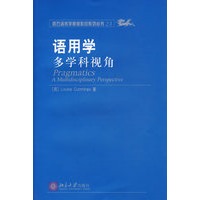
| List of Figures and Tables Acknowledgements Preface 1 The Multidisciplinary Nature of Pragmatics 1.1 Pragmatics and its Academic Neighbours 1.2 Pragmatics: A Standard Definition 1.2.1 Information 1.2.2 Encoding 1.2.3 Convention 1.2.4 Context 1.2.5 Use 1.3 Pragmatic Concepts and Theories 1.3.1 Speech act theory 1.3.2 Implicature theory 1.3.3 Relevance theory 1.3.4 Deixis 1.3.4.1 Person and social deixis 1.3.4.2 Time deixis 1.3.4.3 Place deixis 1.3.4.4 Discourse deixis 1.3.5 Presupposition Notes 2 Theories of Meaning 2.1 Approaches to the Study of Meaning 2.2 Meaning: A Three-part Approach 2.3 A Referential Approach to Meaning 2.3.1 Philosophical foundations: Tarski and Davidson 2.3.2 Truth-conditional semantics 2.3.3 Referential meaning and other disciplines 2.4 A Psychologistic Approach to Meaning 2.4.1 The necessity of psychologistic meaning:Chomsky and Fodor 2.4.2 Pragmatics, the language of thought and related notions 2.4.3 Other disciplines, the language of thoughtand related notions 2.5 A Social Approach to Meaning 2.5.1 Discourse analysis and conversation analysis Notes 3 Inferences 3.1 Pragmatics and Inference 3.2 Deductive Inferences 3.2.1 Three types of syllogism 3.2.2 Deductive inferences and semantic meaning 3.2.3 Deduction, reasoning and utterance interpretation 3.3 Elaborative Inferences 3.3.1 The psychology of elaborative inferences 3.3.2 Elaborative inferences, knowledge and AI 3.3.3 Elaborative inferences and pragmatics 3.4 Conversational Inferences 3.4.1 Grice on deriving implicatures 3.4.2 Recovering implicatures: The views of other theorists 3.4.3 Psychology and conversational inferences Notes 4 Relevance Theory 4.1 Overview 4.2 Relevance and Communication 4.3 Relevance and Cognition 4.4 A Philosophical Criticism of Relevance Theory 4.4.1 Logical positivism: Some background 4.4.2 Putnam on positivism 4.4.3 The scientific reductionism of relevance theory 4.4.3.1 Challenging reductionism I: Elimination rules 4.4.3.2 Challenging reductionism 2:Deduction and comprehension 4.4.3.3 Challenging reductionism 3:Functional confirmation 4.5 Conclusion Notes 5 Pragmatics and Mind 5.1 The Need for a Pragmatic Study of Mind 5.2 Language and Mind: Some Historical Antecedents 5.3 The Modularity of Mind Thesis 5.3.1 Representation 5.3.2 Computation 5.3.3 Organisation 5.4 Pragmatics and Modularity 5.4.1 Kasher on the modularity of pragmatics 5.4.1.1 Pragmatic module 5.4.1.2 Pragmatic central system 5.4.1.3 Pragmatic interface 5.4.2 Wilson and Sperber on the modularity of pragmatics 5.5 If not Modularity, then What? Notes 6 Argumentation and Fallacies of Reasoning 6.1 Pragmatics and Argument 6.2 What Is an Argument? A Fallacy? 6.3 Six Theoretical Frameworks 6.4 A Pragmatic Turn in the Study of Argument 6.5 Pragma-Dialectics:An Advance in the Study of Argumentation? 6.6 Methodology: Reconstruction and Evaluation 6.6.1 Reconstruction 6.6.2 Evaluation Notes 7 Habermas and Pragmatics 7.1 Why Study Habermas? 7.2 Expanding Reason: Habermas on Positivism 7.3 Habermas on Language 7.4 Criticising Habermas: A Putnamian Challenge 7.5 Conclusion Notes 8 Artificial Intelligenee and Pragmatics 8.1 Why Study Artificial Intelligence? 8.2 Pragmatics: Implications for AI 8.3 AI on Pragmatics 8.3.1 Syntactic and semantic representations 8.3.2 Knowledge representation 8.3.3 Reasoning 8.3.4 Rationality principles 8.4 Is AI possible? Notes 9 Language Pathology and Pragmatics 9.1 When Pragmatics Goes Wrong 9.2 Problems of Definition 9.2.1 Speech acts 9.2.2 Context 9.2.3 Listener knowledge 9.2.4 Conversational maxims and implicature 9.2.5 Inferences 9.2.6 Knowledge 9.2.7 Non-literal meaning 9.2.8 Deixis 9.2.9 Conversation analysis and discourse analysis 9.3 Pragmatic Disorders 9.3.1 Developmental language disorder 9.3.2 Autism 9.3.3 Learning disability 9.3.4 Left-hemisphere damage 9.3.5 Right-hemispkere damage 9.3.6 Closed-head injury 9.3.7 Alzheimer's disease 9.3.8 Schizophrenia 9.4 What Can We Learn from Pragmatic Disorders? Notes 10 Beyond Disciplines 10.1 Multidisciplinary Pragmatics 10.2 The Relationship of Other Disciplines to Pragmatics 10.2.1 Philosophy 10.2.2 Psychology 10.2.3 Artificial intelligence 10.2.4 Language pathology 10.3 The Relationship of Pragmatics to Other Disciplines 10.4 New Topics and Disciplines Notes Bibliography Index |



 内容加载中,请稍后...




商品评论(0条)