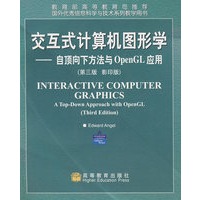
| 本套教学用书的特点: 权威性——教育部高等教育司推荐、教育部高等学校信息科学与技术引进教材专家组遴选。 系统性——覆盖计算机专业主干课程和非计算机专业计算机基础课程; 先进性——著名计算机专家近两年的最新著作,内容体系先进; 经济性——价格与国内自编教材相当,是国内引进教材价格最低的。 This is third edition of this widely adopted textbook.It gets beginners creating exciting interactive graphics applications quickly using OpenGL,the most widely used 3D graphics API in the industry,and provides a solid background for future work in computer graphics,The book covers all topics required for a fundamental course in computer graphics,such as light-material interactions,shading,modeling,curves and surfaces,antialiasing,texture mapping,and compositing,as well as hardware issues. This edition includes an expanded breadth and depth of material to account for new developments in the field,including new material on image processing,texture mapping,multirendering,image-based rendering,and parallel rendering,as well as more material on interaction using selection mode,smooth animations,object-oriented graphics and scene graphics,and ray tracing and radiosity. Included is a CD-ROM with OpenGL resources and book supplements. |
| Edward Angel is currently a professor of Commputer Sicience,Electrical and Computer Engineering and Media Arts at the university of new mexico.He was recently named the Director of the Art tech Center at UNM in the College of Fine Arts.Professor Angel received his Ph.D.in electrical engineering from the university of Southern California in 1968 and has since held visiting positions in Sweden,India,and England.his present research interests focus on computer graphics and scientific visualization. |
| Preface Chapter 1 Graphics Systems and Models 1.1 Applications of Computer Graphics 1.1.1 Display of Information 1.1.2 Design 1.1.3 Simulation and Animation 1.1.4 User Interfaces 1.2 A Graphics System 1.2.1 Pixels and the Frame Buffer 1.2.2 Output Devices 1.2.3 Input Devices 1.3 Images: Physical and Synthetic 1.3.1 Objects and Viewers 1.3.2 Light and Images 1.3.3 Ray Tracing 1.4 The Human Visual System 1.5 The Pinhole Camera 1.6 The Synthetic-Camera Model 1.7 The Programmer's Interface 1.7.1 Application Programmer's Interfaces 1.7.2 The Pen-Plotter Model 1.7.3 Three-Dimensional APIs 1.7.4 A Sequence of Images 1.7.5 The Modeling-Rendering Paradigm 1.8 Graphics Architectures 1.8.1 Display Processors 1.8.2 Pipeline Architectures 1.8.3 Transformations 1.8.4 Clipping 1.8.5 Projection 1.8.6 Rasterization 1.8.7 Performance Characteristics 1.9 Summary and Notes 1.10 Suggested Readings Exercises Chapter 2 Graphics Programming 2.1 The Sierpinski Gasket 2.2 Programming Two-Dimensional Applications 2.2.1 Coordinate Systems 2.3 The OpenGL API 2.3.1 Graphics Functions 2.3.2 The Graphics Pipeline and State Machines 2.3.3 The OpenGL Interface 2.4 Primitives and Attributes 2.4.1 Polygon Basics 2.4.2 Polygon Types in OpenGL 2.4.3 Drawing a Sphere 2.4.4 Text 2.4.5 Curved Objects 2.4.6 Attributes 2.5 Color 2.5.1 RGB Color 2.5.2 Indexed Color 2.5.3 Setting of Color Attributes 2.6 Viewing 2.6.1 Two-Dimensional Viewing 2.6.2 The Orthographic View 2.6.3 Matrix Modes 2.7 Control Functions 2.7.1 Interaction with the Window System 2.7.2 Aspect Ratio and Viewports 2.7.3 The main, display, and myinit Functions 2.7.4 Program Structure 2.8 The Gasket Program 2.9 Polygons and Recursion 2.10 The Three-Dimensional Gasket 2.10.1 Use of Three-Dimensional Points 2.10.2 Use of Polygons in Three Dimensions 2.10.3 Hidden-Surface Removal 2.11 Summary and Notes 2.12 Suggested Readings Exercises Chapter 3 Input and Interaction 3.1 Interaction 3.2 Input Devices 3.2.1 Physical Input Devices 3.2.2 Logical Devices 3.2.3 Measure and Trigger 3.2.4 Input Modes 3.3 Clients and Servers 3.4 Display Lists 3.4.1 Definition and Execution of Display Lists 3.4.2 Text and Display Lists 3.4.3 Fonts in GLUT 3.5 Programming Event-Driven Input 3.5.1 Using the Pointing Device 3.5.2 Window Events 3.5.3 Keyboard Events 3.5.4 The Display and Idle Callbacks 3.5.5 Window Management 3.6 Menus 3.7 Picking 3.7.1 Picking and Selection Mode 3.8 A Simple Paint Program 3.9 Animating Interactive Programs 3.9.1 The Rotating Square 3.9.2 Double Buffering 3.9.3 Other Buffering Problems 3.10 Design of Interactive Programs 3.10.1 Toolkits, Widgets, and the Frame Buffer 3.11 Logic Operations 3.11.1 Drawing Erasable Lines 3.11.2 XOR and Color 3.11.3 Cursors and Overlay Planes 3.12 Summary and Notes 3.13 Suggested Readings Exercises Chapter 4 Geometric Objects and Transformations Chapter 5 Viewing Chapter 6 Shading Chapter 7 Discrete Techniques Chapter 8 Implementation of a Renderer Chapter 9 Hierarchical and Object-Oriented Modeling Chapter 10 Curves and Surfaces Chapter 11 Procedural Methods Chapter 12 Visualization Chapter 13 Advanced Rendering Appendix A Sample Programs Appendix B Spaces Appendix C Matrices References Function Index Subject Index |


 内容加载中,请稍后...







商品评论(0条)