最 低 价:¥44.10
定 价:¥59.00
作 者:(美)尼尔森(Nielsen,M.A.),(美)艾萨克(Isaac,L.) 著 著
出 版 社:高等教育出版社
出版时间:2003-8-1
I S B N:9787040135022

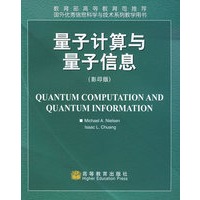
| 本套教学用书的特点: 权威性——教育部高等教育司推荐、教育部高等学校信息科学与技术引进教材专家组遴选。 系统性——覆盖计算机专业主干课程和非计算机专业计算机基础课程; 先进性——著名计算机专家近两年的最新著作,内容体系先进; 经济性——价格与国内自编教材相当,是国内引进教材价格最低的。 This text is comprehensive introduction to the main ideas and techniques of the field of quantum computation and quantum in formation.Until now,the rapid rate of profress and its cross-disciplinary nature have made it difficult for newcomers to the field to obtain a broad overview of the most important techniques and results. Michael Nielsen and lsaac Chuang ask the question:what are the ultimate physical limits to computation and communication? They describe in detail such remarkable effects as fast quantum algorithms,quantum teleportation,quantum cryptography and quantum error-correction.A wealth of accompanying figures and exercses illustrate and develop the material in more depth.A special feature is the tutorial introductions to quantum mechanics and computer science included in Part I of the book,ensuring that the subject is accessible even without a background in physics or computer science.In Part Ⅱ,the authors present quantum computation,and describe what a quantum computer is,how it can be used to solve problems faster than familiar'classical'computers,and the real-world implementation of quanrum computers.Part Ⅲ concludes the book with an in-depth treatment of quantum information,explaining how quantum states can be used to perform remarkable feats of communication,together with a discussion of how it is possible to protect quantum states against the effects of noise. This exciting text will be of interest to beginning graduate students and researchers in physics,computer science,mathematics,and electrical engineering with an interest in quantum computation and quantum information,and may be used as a text in courese on the subject. |
| Michael nielsen is a Postdoctoral research fellow at the university of Queensland.he was born in Brisbane,Austalia,and received his education at the University of Queensland,obtaining postgraducate degrees in mathematics and physics before receiving his Ph.D.in Physics as a Fulbright Scholar at the University of new mexico.he has held a Vistiong position at the los Alamos national Laboratory,and was the Tolman postdoctoral Fellow at the California Institute of technology. |
| Preface Acknowledgements Nomenclature and notation PART I: Fundamental concepts 1. Introduction and overview 1.1 Global perspectives 1.2 Quantum bits 1.3 Quantum computation 1.4 Quantum algorithms 1.5 Experimental quantum information processing 1.6 Quantum information 2. Introduction to quantum mechanics 2.1 Linear algebra 2.2 The postulates of quantum mechanics 2.3 Application:superdese coding 2.4 The Density operator 2.5 The Schmidt decompostion and purifications 2.6 EPR and the Bell inequality 3. Introduction to computer science …… PART II: Quantum computation 4. Quantum circuits 5. The quantum Fourier transform 6. Quantum search algorithms 7. Quantum computers: physical realization PART III: Quantum information 8. Quantum noise, open quantum systems, and quantum operations 9. Distance measures for quantum information 10. Quantum error-correction 11. Entropy and information 12. Quantum information theory APPENDICES Appeddix 1. Notes on basic probability theory Appeddix 2. Group theory Appeddix 3. Approximating quantum gates: the Solovay-Kitaev theorem Appeddix 4. Number theory Appeddix 5. Public-key cryptography and the RSA cryptosystem Appeddix 6. Proof of Lieb's theorem Bibliography Index |


 内容加载中,请稍后...



商品评论(0条)