最 低 价:¥26.90

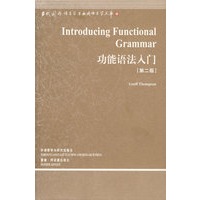
| Foreword Acknowledgements 1 The purposes of linguistic analysis 1.1 Starting points 1.1.1 Going in through form 1.1.2 Going in through meaning 1.2 Language, context and function: a preliminary exploration Exercise 2 Recognizing clauses and clause constituents 2.1 Breaking up the sentence - and labelling the parts 2.1.1 Recognizing constituents 2.1.2 Structural and functional labels 2.2 Ranks Exercises 3 An overview of functional grammar 3.1 Three kinds of meaning 3.1.1 The three metafunctions 3.1.2 Three kinds of function in the clause 3.1.3 Three kinds of structure in the clause 3.1.4 Showing the options: systems networks 3.1.5 A fourth metafunction 3.2 Register and genre 3.2.1 Register (and the corpus) 3.2.2 Genre Exercise 4 Interacting: the interpersonal metafunction 4.1 Introduction 4.2 Roles of addressers and audience 4.3 Mood 4.3.1 The structure of the Mood 4.3.2 Identifying Subject and Finite 4.3.3 Meanings of Subject and Finite 4.3.4 Mood in non-declarative clauses 4.3.5 Mood in text 4.3.6 The Residue 4.3.7 Modal Adjuncts 4.4 Modality 4.4.1 Modality and polarity 4.4.2 Types of modality 4.4.3 Modal commitment 4.4.4 Modal responsibility 4.4.5 Modality in text 4.5 Appraisal 4.6 Interaction and negotiation 4.7 Interaction through text Exercises 5 Representing the world: the experiential metafunction 5.1 Introduction 5.2 Transitivity: processes and participants 5.2.1 Material processes 5.2.2 Mental processes 5.2.3 Relational processes 5.2.4 Verbal processes 5.2.5 Other types of process 5.2.6 Other participant roles 5.2.7 Circumstances 5.2.8 Transitivity in text 5.3 More complex aspects of transitivity 5.3.1 More on material processes 5.3.2 More on mental processes 5.3.3 More on relational processes 5.3.4 Processes in verbal group complexes 5.3.5 Participants in causation 5.4 Transitivity patterns in text 5.5 Ergativity Exercises 6 Organizing the message: the textual metafunction - Theme 6.1 Introduction 6.2 Theme 6.3 Identifying Theme 6.3.1 Theme in declarative clauses 6.3.2 Theme in non-declarative clauses 6.4 Special thematic structures 6.4.1 Thematic equatives 6.4.2 Predicated Theme 6.4.3 Thematized comment 6.4.4 Preposed Theme 6.4.5 Passive clauses and Theme 6.5 Theme in clause complexes 6.6 Multiple Theme 6.6.1 Conjunctions in Theme 6.6.2 Conjunctive and modal Adjuncts in Theme 6.6.3 Textual, interpersonal and experiential elements in Theme 6.6.4 Interrogatives as multiple Themes 6.7 Some problems in Theme analysis 6.7.1 Existential 'there' in Theme 6.7.2 Theme in reported clauses 6.7.3 Interpolations in Theme 6.7.4 Preposed attributives 6.8 Theme in text 6.9 A final note on identifying Theme Exercises 7 Organizing the message: the textual metafunetion - cohesion 7.1 Cohesion and coherence 7.2 Reference and ellipsis 7.2.1 Reference 7.2.2 Ellipsis 7.3 Conjunction 7.4 Cohesion in text Exercise 8 Clauses in combination 8.1 Introduction 8.2 Units of analysis 8.3 Types of relations between clauses 8.3.1 Logical dependency relations 8.3.2 Logico-semantic relations 8.4 Expansion 8.4.1 Elaborating 8.4.2 Extending 8.4.3 Enhancing 8.5 Projection 8.5.1 Quotes and reports 8.5.2 Facts 8.5.3 Projection in text Exercises 9 Grammatical metaphor 9.1 Introduction 9.2 Grammatical metaphor 9.3 Experiential and logical metaphors 9.4 Interpersonal metaphors 9.5 Textual metaphor 9.6 A cautionary note Exercises 10 Implications and applications of functional grammar 10.1 Three-dimensional analysis of texts 10.2 A summary review of functional grammar 10.3 Using functional grammar 10.4 Closing Answers to exercises Further reading References Index |



 内容加载中,请稍后...





商品评论(0条)