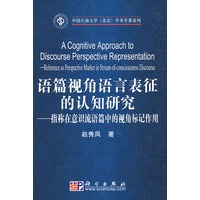
| 赵秀凤,山东济阳人,1986年考入山东大学外语系。1993年毕业于山东大学,获文学硕士学位。2003年~2006年在北京师范大学深造,获英语语言文学博士学位,师从田贵森教授。1993年至今执教于中国石油大学(北京)外语系,现为外语系副主任、教授、硕士生导师。1998年8月~1999年2月在美国怀俄明大学做访问学者。2001年4月~2002年4月,在日本福井县做国际交流员。 曾先后在《外语学刊》、《外语教学》、《解放军外国语学院学报》、《四川外语学院学报》等外语类核心期刊和外语界专业期刊发表学术论文20余篇,并主编或参编教材、译著多部。研究方向:认知语言学、文体学、语篇分析。 |
| 丛书序 序 自序 Chapter 1 Introduction 1.1 Discourse perspective 1.2 Discourse perspective representation 1.3 Discourse perspective representation in stream-of-consciousness fiction 1.4 Reference 1.5 Objectives of this study 1.6 Data and methodology 1.7 Organization of the book Chapter 2 Previous Researches on Discourse Perspective Representation 2.1 Approaches to discourse perspective representation 2.1.1 Formalistic approaches 2.1.2 Functional approaches 2.1.3 Cognitive approaches 2.2 Cognitive studies on reference 2.2.1 Langacker: epistemic footing of reference 2.2.2 Fauconnier: accessible space of reference 2.2.3 Ariel: addressee-oriented accessibility 2.2.4 Chafe: protagonist-oriented accessibility 2.2.5 Li & Zubin: discourse continuity and perspective taking 2.3 Summary Chapter 3 A Cognitive Model to Discourse Perspective Representation 3.1 Theoretical foundations 3.1.1 Preliminary assumptions 3.1.2 Mental Space Theory: DPR as mental space configuration 3.1.3 Ground and viewing arrangement: DPR as ground configuration 3.2 A cognitive model to DPR construction 3.2.1 Preliminaries to DPR construction 3.2.2 A ground-based model 3.3 Specific illustrations to the model 3.3.1 Categorization of the representational modes 3.3.2 Expressive/reportive representation 3.3.3 Motivations for ground configuration 3.4 Summary Chapter 4 Ground Alignment and Reference to the Experiencer 4.1 Grounding nature of referring expressions 4.1.1 Components of referring expressions 4.1.2 Grounding and coding the experiencer 4.2 G-alignment and reference to the experiencer 4.2.1 Coded as full NPs 4.2.2 Coded as reduced NPs 4.3 G-alignment and reference to the experiencer 4.3.1 Non-overt code for maximal subjectivity 4.3.2 Coded as first person pronouns 4.3.3 Coded as second person pronouns 4.3.4 Coded as third person NPs 4.3.5 Summary: mental model of reality and self-reference 4.4 Blend alignment and third person reflexives 4.4.1 Cognitive structure of reflexives 4.4.2 Coded as unbound reflexives 4.4.3 Coded as long-distance bound reflexives 4.5 Degree of objectification and self-referring expressions 4.6 Summary Chapter 5 Ground Alignment and Reference to the Experienced Object 5.1 Preliminaries on reference to the experienced object 5.1.1 Relevant issues 5.1.2 Ground configurations for reference to the experienced in general 5.2 G-alignment and reference to the experienced object 5.2.1 Schematic reference from omnipresence for detachment 5.2.2 Transparent reference from omniscience for unified reportiveness 5.3 G'-alignment and reference to the experienced object 5.3.1 Non-basic categorized reference for expressiveness 5.3.2 (In)definite reference for expressiveness 5.3.3 Perspectivized reference for displaced expressivity 5.4 Co-alignment and reference to the experienced object 5.4.1 Metaphorical reference for dramatization 5.4.2 Opaque reference for the tinge of expressiveness 5.5 Summary Chapter 6 Ground Configuration and Reference Distribution 6.1 Ground-based accessibility 6.1.1 Epistemic nature of grounding 6.1.2 Access path in space configurations 6.1.3 A model of ground-based accessibility 6.2 Distribution of reference to the experiencer 6.2.1 Suppressed reference to the experiencer 6.2.2 Reference distribution in discourses with parentheticals 6.3 Distribution of reference to the experienced object 6.3.1 Marked pronominal reference for immediacy 6.3.2 Marked nominal reference for detachment 6.4 Ground confgurafion and categorical reference interaction 6.4.1 Local reference coordination and degree of expressiveness 6.4.2 Global reference distribution and ground shifts 6.5 The interplay of reference and other devices in DPR categorization... 6.6 Summary Chapter 7 Conclusion 7.1 Summary 7.2 Limitations and implications Bibliography Appendix List of Tables Table 3.1 DPR components in fictional narrative discourse Table 3.2 Parameters of ground configuration Table 4.1 References to self and others (we, us, our) in Samples from Ulysses Table 4.2 Occurrence of LDB and unbound ziji (自己) in SOC fiction Table 4.3 Occurrence of LDB and unbound English reflexives in SOC fiction Table 4.4 References to Self in sampled passages from Ulysses Table 6.1 Correlation between references and degree of expressiveness/reportiveness Table 6.2 Correlations among ground alignment, space configuration and expressiveness |




 内容加载中,请稍后...




商品评论(0条)