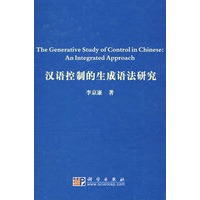
| 《汉语控制的生成语法研究》在生成语法的原则与参数理论框架内对汉语的控制进行研究,即对汉语空主语PRO的分布和释义进行探讨。《汉语控制的生成语法研究》认为虽然汉语在形态上不存在限定与非限定的区分,但它可通过词汇手段标记这一区分,并基于以上观点,尝试性地提出区分限定与非限定的标准:在小句中,能够被体副词(aspectual adverbial)“已经(已)”、“正在(正,在)”和“将要(将)”修饰的动词为限定动词,不能被这些体副词修饰的动词为非限定动词。根据这一标准,汉语中的兼语结构、连动结构、动补结构和动词主语结构中存在限定与非限定的区分。值得注意的是,限定从句跟体状语是可选的,有的限定从句因为主句动词的特性而不能跟体状语,但这并不能否定该从句是限定从句,根据以上标准,汉语的兼语结构、连动结构、动词补语结构和动词主语结构存在限定与非限定的区分,PRO出现这些结构中非限定从句的主语位置。 |
| 序 Acknowledgements Abstract 摘要 Abbreviations Chapter 1 Introduction 1.1 Control Theory: An Overview 1.1.1 Definitions of Control 1.1.2 Chomskys Typology of Empty Categories 1.1.3 Basic Questions Concerning Control 1.2 Typology of Control 1.2.1 Obligatory Control Versus Non-obligatory Control 1.2.2 Subject Control Versus Object Control 1.2.3 Split Control Versus Non-split Control 1.2.4 Implicit Control 1.2.5 Landaus (2000) Typology of Control 1.3 Two Generalizations Concerning Control 1.3.1 Bachs Generalization 1.3.2 Vissers Generalization 1.3.3 Intermediate Summary 1.4 The Goal of the Book 1.5 The Organization of the Book Chapter 2 Major Approaches to the Study of Control: A Critical Review 2.1 The Study of Control Under the Syntactic Approach 2.1.1 The Syntactic Study of Control Under the GB Framework 2.1.1.1 Chomskys Study of Control Under the GB Framework 2.1.1.2 Manzinis Study of Control Under the GB Framework 2.1.1.3 James Huangs Study of Control in Chinese Under the GB Framework 2.1.1.4 Battistellas Study of Control in Chinese Under the GB Framework 2.1.2 The Syntactic Study of Control Under the MP Framework 2.1.2.1 Chomsky and Lasniks Study of Control Under the MP Framework 2.1.2.2 Hornsteins Movement Analysis of Control Under the MP Framework 2.1.2.3 Manzini and Roussous Study of Control Under the MP Framework 2.1.3 The Syntactic Study of Control Under the Framework of Lexical-Functional Grammar 2.2 The Study of Control Under the Semantic Approach 2.2.1 Thematic Identity Condition and Thematic Distinctness Condition 2.2.2 A Lexical-Thematic Theory of Control in Chinese 2.2.3 Culicover and Wilkinss Coindexing Rule 2.2.4 Sag and Pollards Controller Assignment Principle 2.3 The Study of Control Under the Pragmatic Approach 2.4 Summary Chapter 3 The Distinction Between Finiteness and Non-finiteness in Chinese 3.1 Overview 3.2 Proponents of the Finiteness Versus Non-finiteness Distinction in Chinese 3.2.1 James Huangs Arguments for the Finiteness Versus Non- finiteness Distinction in Chinese 3.2.2 Audrey Lis Arguments for the Finiteness Versus Non-finit-eness Distinction in Chinese 3.2.3 Shi Yuzhis Arguments for the Finiteness Versus Non-finit-eness Distinction in Chinese 3.3 Opponents of the Finiteness Versus Non-finiteness Distinction in Chinese 3.3.1 Xus Arguments Against the Finiteness Versus Non-finitenessDistinction in Chinese 3.3.2 Yan Huangs Arguments against the Finiteness Versus Non- finiteness Distinction in Chinese 3.3.3 Hu, Pan and Xus Arguments against the Finiteness Versus Non-finiteness Distinction in Chinese 3.4 Our Arguments for the Distinction Between Finit- eness and Non-finiteness in Chinese 3.4.1 Definitions of Finiteness and Non-finiteness 3.4.1.1 The Definitions of Finiteness and Non-finiteness in a Narrow Sense 3.4.1.2 The Definitions of Finiteness and Non-finiteness in a Broad Sense 3.4.2 A New Criterion for the Distinction Between Finiteness and Non-finiteness in Chinese 3.4.3 The Constructions that Distinguish Finiteness from Non-finiteness in Chinese 3.4.3.1 The Pivotal Construction 3.4.3.2 The Serial Verb Construction 3.4.3.3 The Verbal Complement Construction 3.4.3.4 The Verbal Subject Construction 3.5 Summary Chapter 4 The Distribution and Interpretation of PRO in Chinese: A Tentative Account 4.1 The Distribution of PRO in Chinese 4.1.1 The Distribution of PRO in the Pivotal Construction 4.1.2 The Distribution of PRO in the Serial Verb Construction 4.1.3 The Distribution of PRO in the Verbal Complement Construction 4.1.4 The Distribution of PRO in the Verbal Subject Construction 4.2 The Interpretation of PRO in Chinese 4.2.1 The Interpretation of PRO in the Pivotal Construction 4.2.2 The Interpretation of PRO in the Serial Verb Construction 4.2.3 The Interpretation of PRO in the Verbal Complement Construction 4.2.4 The Interpretation of PRO in the Verbal Subject Construction-. 4.3 An Integrated Theory for the Interpretation of PRO in Chinese 4.4 Summary Chapter 5 Conclusions 5.1 Concluding Remarks 5.2 Suggestions for Further Study Bibliography |


 内容加载中,请稍后...





商品评论(0条)