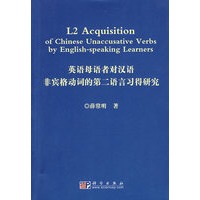
| 本书研究了成人英语母语者对汉语非宾格动词的第二语言习得过程。研究结果显示,与心理动词的习得相比较,以汉语为第二语言的学习者更容易在非宾格动词上出现使动错误;在三个使动习得上,复合使动结构对学习者来说最难掌握。 |
| 序 Acknowledgements Abstract 中文摘要 Chapter 1 Introduction 1.1 Research Orientation 1.2 The Unaccusative Verbs: the Target of Research 1.3 Rationale for the Study 1.4 Key Research Questions 1.5 Organization of the Book Chapter 2 In Search of Theoretical Foundation 2.0 Introduction 2.1 Empirical Basis of UTH 2.2 The Single-Argument Linking Rule 2.3 Three Stages of the Unaccusative Acquisition in L2 English 2.4 General Predictions of UTH 2.5 A General Comment on UTH Chapter 3 Cross-linguistic Analysis of Unaccusativity 3.0 Introduction 3.1 An Overview of Unaccusativity 3.1.1 Unaccusative Hypothesis 3.1.2 Unaccusativity Hierarchy 3.1.3 Approaches to Unaccusativity 3.2 Unaccusativity of English and Other Languages 3.2.1 Deep vs. Surface Unaccusativity 3.2.2 Definiteness Effect (DE) 3.2.3 Diagnostics for Unaccusativity 3.2.4 The Passive vs. the Unaccusative 3.2.5 Summary 3.3 Issues Pertaining to Chinese Unaccusativity 3.3.1 Subclasses of Chinese Unaccusatives 3.3.2 Surface Unaccusativity 3.3.3 DE of Chinese Unaccusativity 3.3.4 Diagnostics for Chinese Unaccusativity 3.3.5 The Unaccusative and the Passive in Chinese 3.4 Summary and Conclusions Chapter 4 Predictions on L2 Acquisition of Chinese Unaceusatives byEnglish-L1 Learners 4.0 Similarities and Differences Between English and ChineseUnaccusativity: A Revisit 4.1 Implications of Cross-linguistic Differences for L2 Acquisition ofChinese Unaccusatives 4.1.1 L1 Transfer and Markedness Theories 4.1.2 Effect of Markedness on L2 Acquisition of ChineseUnaccusatives 4.2 Research Hypotheses Chapter 5 The Empirical Study 5.0 Research Design 5.1 Participants 5.2 Instrumentation …… Chapter6 Results for Research Hypotheses Testing Chapter7 General Discussion Chapter8 Conclusions,pedagogical Implications ,and Recommendations for Further Research Appendix A Tbles1-6 Appendix B Research Instruments Appendix C An Example Test of HSK List of Tables List of Figures |

 内容加载中,请稍后...






商品评论(0条)