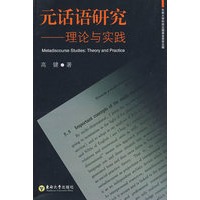
| 《元话语研究:理论与实践》对广大科研工作者科研论文的撰写和投稿亦具有一定的借鉴价值。 |
| 高健,女,南京人,文学博士,副教授,硕士生导师,先后毕业于武汉大学和上海外国语大学,目前任教于东南大学外国语学院英语系。2008年11月至2009年10月受国家留学基金管理委员会资助赴美国普度大学英语系从事对比修辞和二语习得研究。主要研究方向为对比修辞、语篇分 析、学术用途英语、二语习得和跨文化交流。 |
| Acknowledgements Preface Part One: What is metadiscourse? Chapter 1 Metadiscourse: defmitions 1.1 Definitions revisited 1.2 Defining metadiscourse in academic written communication Chapter 2 Metadiscourse: functions and classifications 2.1 Functions revisited 2.2 Classifications revisited Chapter 3 Debates and issues on metadiscourse 3.1 Non-propositional metadiseourse? 3.2 Metadiscourse with a different level of meaning? 3.3 Metadiscourse across cultures Part Two: Theories of metadiscourse Chapter 4 Existing approaches to metadiscourse 4.1 The rhetoric approach 4.2 The functional approach 4.3 The speech act approach Chapter 5 Towards a multi-dimensional approach to metadiscourse in academic written communication 5.1 Hallidays metafunctions of language : Metadiscourse and its interpersonal meanings 5.2 Classical rhetorics audience: Metadiscourse and writers credibility 5.3 Social constructionist audience: Metadiscourse, knowledge construction and writers identity 5.4 Face in social interaction: Metadiscourse and writer-reader relationship 5.5 Important concepts of the multi-dimensional approach 5.6 Metadiscourse in written academic communication Chapter 6 Metadiscourse and contrastive rhetoric 6.1 The neo-cuhural approach to contrastive rhetoric 6.2 Metadiscourse and "small" cultures Part Three: Metadiscourse in practice Chapter 7 Metadiscourse in Chinese scholarly texts 7.1 Professional academic writing, RA and metadiscourse 7.2 Method 7.3 Overall results 7.4 Discussion 7.5 Conclusion Part Four: Implications and future study Chapter 8 Metadiscourse in academic English education 8.1 Implications of the multi-dimensional approach and the contrastive rhetoric study 8.2 Advantages of teaching metadiscourse Chapter 9 Future study References Appendix A Appendix B Appendix C |


 内容加载中,请稍后...






商品评论(0条)