最 低 价:¥505.30

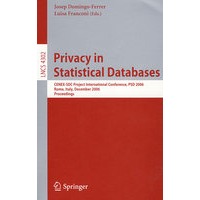
| The LNCS series reports state-of-the-art results in computer science research,development,and education,at a high level and in both printed and electronic form.Enjoying tight cooperation with the R&D community,with numerous individuals,as well as with prestigious organizations and societies,LNCS has grown into the most comprehensive computer science research forum available. The scope of LNCS including its subseries LNAI spans the whole range of computer science and information technology including interdisciplinary topics in a variety of application fields.The type of material published traditionally includes. —proceedings (published in time for the respective conference) —post-proceedings (consisting of thoroughly revised final full papers) —research monographs(which may be based on outstanding PhD work,research projects,technical reports,etc.) |
| Methods for Tabular Protection A Method for Preserving Statistical Distributions Subject to Controlled Tabular Adjustment Automatic Structure Detection in Constraints of Tabular Data A New Approach to Round Tabular Data Harmonizing Table Protection: Results of a Study Utility and Risk in Tabular Protection Effects of Rounding on the Quality and Confidentiality of Statistical Data Disclosure Analysis for Two-Way Contingency Tables Statistical Disclosure Control Methods Through a Risk-Utility Framework A Generalized Negative Binomial Smoothing Model for Sample Disclosure Risk Estimation Entry Uniqueness in Margined Tables Methods for Microdata Protection Combinations of SDC Methods for Microdata Protection A Fixed Structure Learning Automaton Micro-aggregation Technique for Secure Statistical Databases Optimal Multivariate 2-Microaggregation for Microdata Protection A 2-Approximation Using the Jackknife Method to Produce Safe Plots of Microdata Combining Blanking and Noise Addition as a Data Disclosure Limitation Method Why Swap When You Can Shuffle? A Comparison of the Proximity Swap and Data Shuffle for Numeric Data Adjusting Survey Weights When Altering Identifying Design Variables Via Synthetic Data Utility and Risk in Microdata Protection Risk, Utility and PRAM Distance Based Re-identification for Time Series, Analysis of Distances Beyond k-Anonymity: A Decision Theoretic Framework for Assessing Privacy Risk Using Mahalanobis Distance-Based Assessment Record Linkage for Disclosure Risk Improving Individual Risk Estimators Protocols for Private Case Studies Software Author Index |



 内容加载中,请稍后...


商品评论(0条)