Daniel Defoe was a Londoner, born c. 1660 at
St. Giles, Cripplegate, the son of James Foe, a tallow-chandler and
member of the Butchers' Company. Daniel began to use the name 'De
Foe' c. 1695. He was educated for the Presbyterian ministry at
Morton's Dissenting Academy at Newington Green, but decided he had
no vocation and instead went into the wholesale hosiery business,
acquiring premises in Cornhill. In 1685 he participated in
Monmouth's unsuccessful rebellion. His business activities were
extended into the wine trade and marine insurance, but in 1692 he
was declared bankrupt. The consequences of this debacle pursued him
for the rest of his life, though he profited from the experience by
becoming an expert in bankruptcy law, which he had some influence
in reforming.
Meanwhile, Defoe was becoming a prolific and
versatile writer, producing pamphlets and books on a wide variety
of topics, including politics, crime, religion, economics,
marriage, topography and superstition. His first extant political
tract (against James II) was published in 1688. Becoming a staunch
supporter of King William, he published early in January 1601 a
verse satire, The True-Born Englishman, championing William and
making merciless fun of English chauvinism, and the poem was an
instant and runaway success. Two years later he brought out The
Shortest Way with the Dissenters, a pamphlet pretending to be by a
High Churchan calling for a root-and-branch extirpation of Dissent.
It caused the enraged Government to have Defoe committed to Newgate
and tried at the Old Bailey, where he was sentenced to stand three
times in the pillory. for the following ten years he acted as a
personal agent for the Secretary of State, Robert Harley, with
whose support he launched an influential periodical, the
Review.
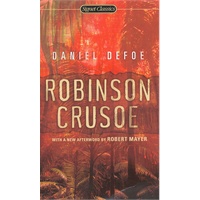
Defoe turned to fiction relatively late in life
and in 1719 published his great imaginative work, Robinson Crusoe.
This was followed in 1722 by Moll Flanders and A Journal of the
Plague Year, and in 1724 by his last important novel, Roxana. Other
major works include a History of the Union (1709); The Family
Instructor (1715); A Tour Through the Whole Island of Great
Britain, a guide-book in three volumes (1724-6); The Political
History of the Devil (1726); A Plan of the English Commerce (1728);
and The Complete English Gentleman (not published until 1890). He
died on April 24, 1731.
|




 内容加载中,请稍后...



商品评论(0条)