| The LNAI series reports state-of-the-art results in artificial intelligence re-search, development, and education, at a high level and in both printed and electronic form. Enjoying tight cooperation with the R&D community, with numerous individuals, as well as with prestigious organizations and societies,LNAI has grown into the most comprehensive artificial intelligence research forum available. The scope of LNAI spans the whole range of artificial intelligence and intelli-gent information processing including interdisciplinary topics in a variety of application fields. The type of material published traditionally includes. -proceedings (published in time for the respective conference) -post-proceedings (consisting of thoroughly revised final full papers) -research monographs (which may be based on PhD work) |
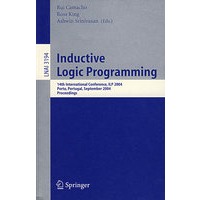
| Invited Papers Automated Synthesis of Data Analysis Programs: Learning in Logic At the Interface of Inductive Logic Programming and Statistics From Promising to Profitable Applications of ILP:A Case Study in Drug Discovery Systems Biology: A New Challenge for ILP Scaling Up ILP:Experiences with Extracting Relations from Biomedical Text Research Papers Macro-Operators Revisited in Inductive Logic Programming Bottom-Up ILP Using Large Refinement Steps On the Effect of Caching in Recursive Theory Learning FOIL-D: Efficiently Scaling FOIL for Multi-relational Data Mining of Large Datasets Learning an Approximation to Inductive Logic Programming Clause Evaluation Learning Ensembles of First-Order Clauses for Recall-Precision Curves: A Case Study in Biomedical Information Extraction Automatic Induction of First-Order Logic Descriptors Type Domains from Observations On Avoiding Redundancy in Inductive Logic Programming Generalization Algorithms for Second-Order Terms Circumscription Policies for Induction Logical Markov Decision Programs and the Convergence of Logical TD(λ) Learning Goal Hierarchies from Structured Observations and Expert Annotations Efficient Evaluation of Candidate Hypotheses in AE-log An Efficient Algorithm for Reducing Clauses Based on Constraint Satisfaction Techniques Improving Rule Evaluation Using Multitask Learning Learning Logic Programs with Annotated Disjunctions A Simulated Annealing Framework for ILP Modelling Inhibition in Metabolic Pathways Through Abduction and Induction First Order Random Forests with Complex Aggregates …… Addendum Author Index |


 内容加载中,请稍后...



商品评论(0条)