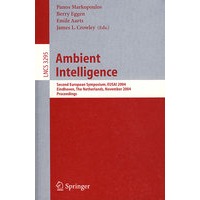
| The LNCS series reports state-of-the-art results in computer science research,development,and education,at a high level and in both printed and electronic form. Enjoying tight cooperation with the R&D community,with numerous individuals,as well as with prestigious organizations and societies,LNCS has grown into the most comprehensive computer science research forum available. The scope of LNCS,including its subseries LNAI,spans the whole range of computer science and information technology including interdisciplinary topics in a variety of application fields. The type of material published traditionally includes. —proceedings (published in time for the respective conference) —post-proceedings (consisting of thoroughly revised final full papers) —research monographs(which may be based on outstanding PhD work,research projects,technical reports,etc.) |
| Ubiquitous Computing: Software Architectures, Communication, and Distribution Super-distributed RFID Tag Infrastructures Using Ontologies to Address Key Issues in Ubiquitous Computing Systems Performance Evaluation of Personal Agent Migration Policies in an Ambient Use Case Scenario QoS Provision Using Dual RF Modules in Wireless LAN Using Cooperative Artefacts as Basis for Activity Recognition Privacy Protection in Memory-Based Collaborative Filtering Context-Aware, 0ntology-Based Service Discovery Context-Based Service Access for Train Travelers System for Monitoring and Coaching of Sportsmen From Imagination to Experience: The Role of Feasibility Studies in Gathering Requirements for Ambient Intelligent Products Context Sensing and Machine Perception Using Integration Frameworks for Developing Context-Aware Applications A Generic Topology for Ambient Intelligence A Distributed Location Sensing Platform for Dynamic Building Models Distributed Feature Extraction for Event Identification Towards an Extensible Context Ontology for Ambient Intelligence Integrating Handhelds into Environments of Cooperating Smart Everyday Objects Remote Code Execution on Ubiquitous Mobile Applications The PLANTS System: Enabling Mixed Societies of Communicating Plants and Artefacts Multiple User Profile Merging (MUPE): Key Challenges for Environment Awareness Human Computer Interaction in Ambient Intelligence Environments Towards a Playful User Interface for Home Entertainment Systems Shaping the Ambience of Homes with Domestic Hypermedia Tangible Computing in Everyday Life: Extending Current Frameworks for Tangible User Interfaces with Personal Objects End-User Configuration of Ambient Intelligence Environments Feasibility from a User Perspective VIEWs: Visual Interaction Enriched Windows …… Algorithms, Ontologies, and Architectures for Learning and Adaptation Author Index |


 内容加载中,请稍后...



商品评论(0条)