最 低 价:¥94.80
定 价:¥120.00
作 者:Irene Nemirovsky 著
出 版 社:1-4000
出版时间:2007-4-10
I S B N: 9781400096275 </td></tr><tr><td width="14%" class

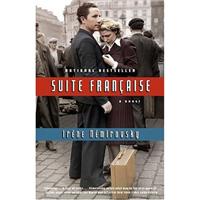
| 《法兰西组曲》(《六月的风暴》)创作于历史的战火之中,它以白描的方式描绘了1940年的巴黎大逃亡,法国几乎所有的家庭都卷入了这悲剧性的混乱之中。伊莱娜?内米洛夫斯基没有放过逃亡中不计其数的怯懦,同样也没有放过人民在这场逃亡中所显现出的团结一致的微弱火花。画面中有被情人抛弃的情妇,有被粗俗平民恶心坏了的大资产阶级,有堵塞了法国各条公路、在突如其来的轰炸中受伤而被丢弃在农庄的伤者……接着,敌人占领了这块麻木而惊恐的土地。和其他很多地方一样,布西小镇不得不迎来德军的进驻。占领军的出现激化了社会矛盾和居民的挫败感,人们醒来了…… 在这样一个读者几乎已经忘记古典小说家魅力的时代,内米洛夫斯基用她生命最后几年的痛苦和光彩夺目的才华,以虚构世界的方式为我们呈现了那个曾经的过去:人物、事件和背景。 卓越亚马逊为您带来英文原版的《六月的风暴》,带您重新回到那个战火纷飞的曾经与过去。 From Publishers Weekly Celebrated in pre-WWII France for her bestselling fiction, the Jewish Russian-born Némirovsky was shipped to Auschwitz in the summer of 1942, months after this long-lost masterwork was composed. Némirovsky, a convert to Catholicism, began a planned five-novel cycle as Nazi forces overran northern France in 1940. This gripping "suite," collecting the first two unpolished but wondrously literary sections of a work cut short, have surfaced more than six decades after her death. The first, "Storm in June," chronicles the connecting lives of a disparate clutch of Parisians, among them a snobbish author, a venal banker, a noble priest shepherding churlish orphans, a foppish aesthete and a loving lower-class couple, all fleeing city comforts for the chaotic countryside, mere hours ahead of the advancing Germans. The second, "Dolce," set in 1941 in a farming village under German occupation, tells how peasant farmers, their pretty daughters and petit bourgeois collaborationists coexisted with their Nazi rulers. In a workbook entry penned just weeks before her arrest, Némirovsky noted that her goal was to describe "daily life, the emotional life and especially the comedy it provides." This heroic work does just that, by focusing—with compassion and clarity—on individual human dramas. (Apr. 18) From The Washington Post's Book World/washingtonpost.com This extraordinary work of fiction about the German occupation of France is embedded in a real story as gripping and complex as the invented one. Composed in 1941-42 by an accomplished writer who had published several well-received novels, Suite Fran?aise, her last work, was written under the tremendous pressure of a constant danger that was to catch up with her and kill her before she had finished. Irène Némirovsky was a Jewish, Russian immigrant from a wealthy family who had fled the Bolsheviks as a teenager. She spent her adult life in France, wrote in French but preserved the detachment and cool distance of the outsider. She and her husband were deported to Auschwitz in 1942, where he was gassed upon arrival and she died in the infirmary at the age of 39. Her manuscript, in minuscule and barely readable handwriting, was preserved by her daughters, who, ignorant of the fact that these notebooks contained a full-fledged masterpiece, left it unread until 60 years later. Once published, with an appendix that illuminates the circumstances of its origin and the author's plan for its completion, it quickly became a bestseller in France. It is hard to imagine a reader who will not be wholly engrossed and moved by this book. Némirovsky's plan consisted of five parts. She completed only the first two before she was murdered. Yet they are not fragmentary; they read like polished novellas. The first, "Storm in June," gives us a cross section of the population during the initial exodus from the capital, when a battle for Paris was expected and people fled helter-skelter south, so that the roads were clogged with refugees of all classes. Némirovsky shows how much caste and money continued to matter, how the nation was not united in the face of danger and a common enemy. In her account, the well-to-do continue to be especially egotistical and petty. And yet a deep, unsentimental sympathy pervades this panorama. Looking up to the sky at enemy planes overhead, the refugees who have to sleep on the street or in their cars "lacked both courage and hope. This was how animals waited to die. It was the way fish caught in a net watch the shadow of the fisherman moving back and forth above them." I can't think of a more chilling and concise image to convey the helplessness of civilians in an air raid. Not being French herself but steeped in French culture may have made it easier for Némirovsky to achieve her penetrating insights with Flaubertian objectivity. She gives us startling, steely etched sketches of both collaboration and resistance among people motivated by personal loyalties and grievances that date from before the war. The second part, "Dolce" (the title -- Italian for "sweet" -- derives from Némirovsky's plan to give the work a musical structure), covers the occupation by the Germans of a small village, from the so-called armistice in June 1940 to the Soviet Union's entry into the war a year later. One can forget that there was a period after the defeat of France when World War II could be seen simply as a war between Germany and Britain. The villagers yearn for peace, and many are indifferent as to who wins, England or Germany, as long as their own men come home. Némirovsky is superb in describing how fraternization comes about, including French girls and women giving in to the attractions of the handsome German occupants -- there are no other men around, most of the French men having been taken prisoner. But the unnatural situation also breeds fierce feelings of resentment and humiliation. Némirovsky embodies this conflict in the story of a woman who falls in love with a German officer and at the same time hides a villager wanted for the murder of another German -- a murder motivated partly by patriotic hatred and partly by marital jealousy. One puzzling omission from the spectrum of conquered and cowering French society is the Jews -- the one group that was more endangered than any other, as Némirovsky knew only too well. Perhaps she wanted to save the fate of the Jews for the next part, which was to be entitled "Captivity." Even so, when one thinks of the threat the Jewish population endured even at this early stage of persecution, one feels the significant gap here. Still, this is an incomparable book, in some ways sui generis. While diaries give us a day-to-day record, their very inclusiveness can lead to tedium; memoirs, on the other hand, written at a later date, search for highlights and illuminate the past from the vantage point of the present. In Némirovsky's Suite Fran?aise we have the perfect mixture: a gifted novelist's account of a foreign occupation, written while it was taking place, with history and imagination jointly evoking a bitter time, correcting and enriching our memory. Reviewed by Ruth Kluger From Booklist Nemirovsky, a young Russian Jewish emigre, became a celebrated novelist in Paris at age 26 in 1929. She wrote eight more novels; then, even though she was certain that she wouldn't survive Germany's occupation of France, she embarked on a grandly symphonic, courageous, and scathing work about France's collaboration with the Nazis. She completed two of five planned movements before she was sent to Auschwitz, a heart-wrenching story meticulously documented in a supplemental section. As for Nemirovsky's masterpiece, it begins with the tumultuous "Storm in June," in which diverse Parisians frantically evacuate Paris during the June 1940 German invasion. Nemirovsky's gift for combining the panoramic with the intimate, high emotion with stinging wit, is reminiscent of Turgenev, Babel, and Berberova. Acutely sensitive to class differences, and mordantly scornful of hypocrisy, she orchestrates a veritable carnival of cowardice, lies, larceny, and murder as a panicked populace drops all pretense of civilization. The second movement, "Dolce," evokes the eye of the storm in the village of Bussy, where German officers are billeted in French homes, and life and love resume. Suite Francaise is a magnificent novel of the insidious devastation of occupation, and Nemirovsky is brilliant and heroic, summoning up profound empathy for all, including regretful German soldiers. Everything about this transcendent novel is miraculous. Donna Seaman From AudioFile These recently rediscovered opening sections of a planned five-part novel by Irene Nemirovsky, who died in Auschwitz in 1942, are cause for rejoicing and for deep mourning for what was lost. Daniel Oreskes reads the first novella, a bleak human comedy of Parisians fleeing the city in chaos, rather pointlessly, it turns out, as the Wehrmacht arrives. Barbara Rosenblat performs the second, in which many characters from the first reappear, about the sometimes subtle, sometimes violent tensions in a French farm village under German occupation, as conquerors and conquered, aristocrats and peasants interact in unaccustomed ways. This is complex, polished, and moving work by Nemirovsky, who must have written at breakneck speed, and by two incomparable actors, a virtually flawless production that will repay multiple listenings. B.G. Winner of AudioFile Earphones Award Bookmarks Magazine Némirovsky wrote Suite Fran?aise as the events that inspired them unfolded simultaneously; that alone makes the work remarkable. The first two novels came to light in 2004 (and were published to great acclaim in France) after Némirovsky's daughters revealed the existence of their mother's notebooks. With the author's notes about her next three novels (Captivity, Battles, and Peace?) included, it's clear that Némirovsky intended to write a sort of War and Peace. Even without Némirovsky's astonishing perspective, critics agree that the novels' witty characterizations, mesmerizing prose, cinematic scenes, and insightful observations make these novels short masterpieces. The New York Times expressed concern over characterization, and Newsday noted the absence of discussion about Jews. Still, Suite Fran?aise may be considered "the last great fiction of the war" (Pittsburgh Post-Gazette). Book Description Beginning in Paris on the eve of the Nazi occupation in 1940. Suite Fran?aise tells the remarkable story of men and women thrown together in circumstances beyond their control. As Parisians flee the city, human folly surfaces in every imaginable way: a wealthy mother searches for sweets in a town without food; a couple is terrified at the thought of losing their jobs, even as their world begins to fall apart. Moving on to a provincial village now occupied by German soldiers, the locals must learn to coexist with the enemy—in their town, their homes, even in their hearts. When Irène Némirovsky began working on Suite Fran?aise, she was already a highly successful writer living in Paris. But she was also a Jew, and in 1942 she was arrested and deported to Auschwitz, where she died. For sixty-four years, this novel remained hidden and unknown. |
| Irène Némirovsky was born in Kiev in 1903 into a wealthy banking family and emigrated to France during the Russian Revolution. After attending the Sorbonne, she began to write and swiftly achieved success with her first novel, David Golder, which was followed by The Ball, The Flies of Autumn, Dogs and Wolves and The Courilof Affair. She died in 1942. From the Hardcover edition. |
 内容加载中,请稍后...


商品评论(0条)