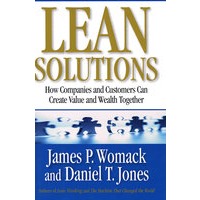
American and European feelings towards Japanese business practices have varied dramatically through the last few decades. In the late 1970s and 1980s, a wave of fear swept through many Western leaders as they contemplated Japan's stunningly rapid rise from the ashes of World War II. Then more recently, as the 1990s and early 2000s saw stagflation gripping the Japanese economy, and knowledge-based innovation in technology and financial services bringing unprecedented prosperity to many Western countries, a feeling of vindication (and sometimes smugness) returned to those same corporate chieftains. Most recently, perhaps, the pendulum of conventional wisdom has begun to swing back to a middle position, in between the extremes of adulation and disdain: respect for the positive contributions of Japanese business culture, without blind acceptance. It's with this spirit that the authors of Lean Solutions offer their insightful observations about process design and service delivery in modern companies.
James Womack and Daniel Jones are well-recognized contributors to the lean-business movement. Lean Solutions is the consultants' fifth book together, following earlier works like Lean Thinking and The Machine That Changed the World, and springs as before from their keen interest in Japanese business methods and philosophy. What compels them to write yet another book, though, given the well-established literature on lean business?
The authors offer an intriguing description of their mission at the beginning of this latest book. Principles of lean design have in fact been adopted by many Western businesses, they acknowledge, and manufacturing quality has steadily risen as a result. Yet customers remain often dissatisfied with their experiences. The cause? To Womack and Jones, the answer rests in a myopic application of lean business principles: companies have successfully improved their manufacturing and product-development environments, but they have not had a large enough view of the overall customer relationship, and of the need for leanness in all aspects of companies' interactions with customers.
Put another way: in Lean Solutions, readers find a new and much broader conceptualization of how lean-business methods--which, to be fair to Womack and Jones, have evolved so that they can claim a global heritage as much as a Far Eastern one--might apply across entire customer experiences, rather than just manufacturing processes. The structure of Lean Solutions centers on 6 requests that the authors believe customers implicitly demand from their vendors: "Solve my problem completely; don't waste my time; provide exactly what I want; deliver value where I want it; supply value when I want it; and reduce the number of decisions I must make to solve my problems."
With a compelling mix of case studies, and illuminating thought experiments in industries ranging as widely as shoe manufacturing, health care delivery, auto repair, and grocery shopping, Womack and Jones walk readers through careful explanations of how lean thinking might be expanded beyond the factory floor to broader business problems. Lean Solutions isn't for all readers. It rests on an appreciation of the large cumulative effects that many small processes can have on business, and it requires patience from those who want to learn the secrets of lean business. --Peter Han
From Booklist
In Lean Thinking (1996), Womack and Jones expanded on the lean manufacturing model developed by Toyota to reduce waste and costs, reduce lead times, and improve quality. Here, they bring lean thinking to the broader world of consumer satisfaction. Traditional mass-consumption thinking has brought us tons of gee-whiz products but more frustration when it comes to actually getting what we want where and when we want it. Through a series of "consumption maps," Womack and Jones highlight the "hassle time" inherent in the ways we shop, travel, and receive essential services, and then they offer novel ways for both consumers and providers to reduce this wasted time. We all know the dissatisfaction of going to the grocery store and finding the very item we need is out of stock. The new models reduce out-of-stock situations drastically by allowing consumers to dictate flow through demand rather than flow being driven by sales projections. Womack and Jones introduce ways to bring lean provision streams to some of our most hassle-laden consumer experiences, including the auto-repair, airline, and health-care industries. We can only hope someone is listening. David Siegfried.
Copyright © American Library Association. All rights reserved.
作者简介
JAME P.WOMACK is the president and founder of the Lean Enterprise Institute(www.lean.org),a nonprofit education and research organization based in Brookline,Masschusetts. |




 内容加载中,请稍后...


商品评论(0条)