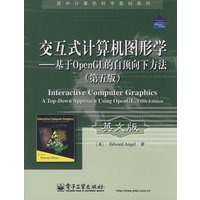
| 本书主要特点: 新!覆盖最新的纹理技术,如多通道纹理映射的凹凸映射;新!扩充了建模和过程建模方法的内容,包括过程噪声;新!扩充了场景图和实时绘制的内容;新!扩充了可编程着色器的内容;重新修订了演示程序。 |
| Edward Angel,美国新墨西哥大学计算机科学系、电气与计算机工程系以及媒体艺术系荣誉退休教授,他曾经是该大学首位兼任教学工作的研究生。Edward获得了美国南加州大学获得哲学博士学位和加州理工学院工程理学士学位。他还是新墨西哥大学艺术、研究、技术和科学实验室(http://artslab.unm.edu)的主任。 |
| CHAPTER 1 GRAPHICS SYSTEMS AND MODELS 1.1 Applications of Computer Graphics 1.1.1 Display of Information 1.1.2 Design 1.1.3 Simulation and Animation 1.1.4 User Interfaces 1.2 A Graphics System 1.2.1 Pixels and the Frame Buffer 1.2.2 Output Devices 1.2.3 Input Devices 1.3 Images: Physical and Synthetic 1.3.1 Objects and Viewers 1.3.2 Light and Images 1.3.3 Image Formation Models 1.4 Imaging Systems 1.4.1 The Pinhole Camera 1.4.2 The Human Visual System 1.5 The Synthetic-Camera Model 1.6 The Programmer's Interface 1.6.1 The Pen-Plotter Model 1.6.2 Three-Dimensional APIs 1.6.3 A Sequence of Images 1.6.4 The Modeling-Rendering Paradigm 1.7 Graphics Architectures 1.7.1 Display Processors 1.7.2 Pipeline Architectures 1.7.3 The Graphics Pipeline 1.7.4 Vertex Processing 1.7.5 Clipping and Primitive Assembly 1.7.6 Rasterization 1.7,7 Fragment Processing 1.8 Programmable Pipelines 1.9 Performance Characteristics Summary and Notes Suggested Readings Exercises CHAPTER 2 GRAPHICS 2.1 The Sierpinski Gasket 2.2 Programming Two-Dimensional Applications 2.2.1 Coordinate Systems 2.3 The OpenGL API 2.3.1 Graphics Functions 2.3.2 The Graphics Pipeline and State Machines 2.3.3 The OpenGL Interface 2.4 Primitives and Attributes 2.4.1 Polygon Basics 2.4.2 Polygon Types in OpenGL 2.4.3 Approximating a Sphere 2.4.4 Text 2.4.5 Curved Objects 2.4.6 Attributes 2.5 Color 2.5.1 RGB Color 2.5.2 Indexed Color 2.5.3 Setting of Color Attributes 2.6 Viewing 2.6.1 The Orthographic View 2.6.2 Two-Dimensional Viewing 2.6.3 Matrix Modes 2.7 Control Functions 2.7.1 Interaction with the Window System 2.7.2 Aspect Ratio and Viewports 2.7.3 The main, display, and myinit Functions 2.7.4 Program Structure 2.8 The Gasket Program 2.9 Polygons and Recursion CHAPTER 3 INPUT AND INTERACTION CHAPTER 4 GEOMETRIC OBJECTS AND TRANSFRMATIONS CHAPTER 5 VIEWING CHAPTER 6 LIGHTING AND SHADING CHAPTER 7 FROM VERTICES TO FRAGMENTS CHAPTER 8 DISCRETE TECHNIOUES CHAPTER 9 PROGRAMMABLE SHADERS CHAPTER 10 MODELING AND HIERARCHY CHAPTER 11 PROCEDURAL METHODS CHAPTER 12 CURVES AND SRRFACES CHAPTER 13 ADVANCED RENDERING APPENDIX A SAMPLE PROGRAMS APPENDIX B SPACES APPENDIX C MATRICES APPENDIX D SYNOPSIS OF OPENGL FUNCTIONS References Opengl Function Index Subject Index |


 内容加载中,请稍后...







商品评论(0条)