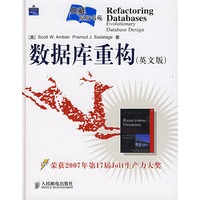
| 本书荣获2007年第17届Jolt大奖的生产效率奖! |
| Scott W.Ambler,世界一流的软件过程改进咨询顾问,开创了敏捷建模、敏捷数据、企业统一过程(Enterprise UP)以及敏捷统一过程方法论。曾在软件开发、JavaOne、OOPSLA、DAMA等会议上作主题发言和演讲。 |
| Chapter 1:Evolutionary Database Development 1.1 Database Refactoring 1.2 Evolutionary Data Modeling 1.3 Database Regression Testing 1.4 Configuration Management of Database Artifacts 1.5 Developer Sandboxes 1.6 Impediments to Evolutionary Database Development Techniques 1.7 What You Have Learned Chapter 2:Database Refactoring 2.1 Code Refactoring 2.2 Database Refactoring 2.3 Categories of Database Refactorings 2.4 Database Smells 2.5 How Database Refactoring Fits In 2.6 Making It Easier to Refactor Your Database Schema 2.7 What You Have Learned Chapter 3:The Process of Database Refactoring 3.1 Verify That a Database Refactoring Is Appropriate 3.2 Choose the Most Appropriate Database Refactoring 3.3 Deprecate the Original Database Schema 3.4 Test Before, During, and After 3.5 Modify the Database Schema 3.6 Migrate the Source Data 3.7 Refactor External Access Program(s) 3.8 Run Your Regression Tests 3.9 Version Control Your Work 3.10 Announce the Refactoring 3.11 What You Have Learned Chapter 4:Deploying into Production 4.1 Effectively Deploying Between Sandboxes 4.2 Applying Bundles of Database Refactorings 4.3 Scheduling Deployment Windows 4.4 Deploying Your System 4.5 Removing Deprecated Schema 4.6 What You Have Learned Chapter 5:Database Refactoring Strategies 5.1 Smaller Changes Are Easier to Apply 5.2 Uniquely Identify Individual Refactorings 5.3 Implement a Large Change by Many Small Ones 5.4 Have a Database Configuration Table 5.5 Prefer Triggers over Views or Batch Synchronization 5.6 Choose a Sufficient Transition Period 5.7 Simplify Your Database Change Control Board (CCB) Strategy 5.8 Simplify Negotiations with Other Teams 5.9 Encapsulate Database Access 5.10 Be Able to Easily Set Up a Database Environment 5.11 Do Not Duplicate SQL 5.12 Put Database Assets Under Change Control 5.13 Beware of Politics 5.14 What You Have Learned 68 Online Resources Chapter 6:Structural Refactorings Common Issues When Implementing Structural Refactorings Drop Column Drop Table Drop View Introduce Calculated Column Introduce Surrogate Key Merge Columns Merge Tables Move Column Rename Column Rename Table Rename View Replace LOB With Table Replace Column Replace One-To-Many With Associative Table Replace Surrogate Key With Natural Key Split Column Split Table Chapter 7:Data Quality Refactorings Common Issues When Implementing Data Quality Refactorings Add Lookup Table Apply Standard Codes Apply Standard Type Consolidate Key Strategy Drop Column Constraint Drop Default Value Drop Non-Nullable Introduce Column Constraint Introduce Common Format Introduce Default Value Make Column Non-Nullable Move Data Replace Type Code With Property Flags Chapter 8:Referential Integrity Refactorings Add Foreign Key Constraint Add Trigger For Calculated Column Drop Foreign Key Constraint Introduce Cascading Delete Introduce Hard Delete Introduce Soft Delete Introduce Trigger For History Chapter 9:Architectural Refactorings Add CRUD Methods Add Mirror Table Add Read Method Encapsulate Table With View Introduce Calculation Method Introduce Index Introduce Read-Only Table Migrate Method From Database Migrate Method To Database Replace Method(s) With View Replace View With Method(s) Use Official Data Source Chapter 10:Method Refactorings 10.1 Interface Changing Refactorings 10.2 Internal Refactorings Chapter 11:Transformations Insert Data Introduce New Column Introduce New Table Introduce View Update Data Appendix:The UML Data Modeling Notation Glossary References and Recommended Reading Index |





 内容加载中,请稍后...







商品评论(0条)