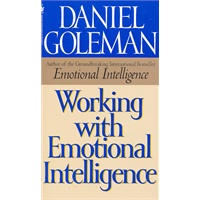
Book Description
In his phenomenal bestseller, Emotional Intelligence, Daniel
Goleman mapped the territory where IQ meets EQ, where we apply what
we know to how we live. Spending over a year on the New York Times
bestseller list, Emotional Intelligence provided the evidence for
what many successful people already knew: being smart isn't just a
matter of mastering facts; it's a matter of mastering your own
emotions and understanding the emotions of the people around
you.Now, in Working With Emotional Intelligence, Goleman shows why
emotional intelligence has become the new yardstick for success for
CEOs and junior hires alike. Drawing on both unparalleled access to
business leaders and in-depth research, he documents that star
performance in every field depends more on emotional intelligence
than IQ or technical skills. And the impact of emotional
intelligence is even greater at the top of the leadership
pyramid.Goleman vividly shows how self-awareness, motivation,
influence, conflict management, and team-building play out in some
of the top corporations in the world today, and points out the
damage done when they are lacking. He also creates a strategy for
the "emotionally intelligent organization" that will shape training
and development programs for years to come.With examples from
real-life businesses, including successes and failures, this
program is a blueprint for all who want to thrive with integrity
and satisfaction in the new global economy.
Amazon.com
Working With Emotional Intelligence takes the concepts from
Daniel Goleman's bestseller, Emotional Intelligence, into the
workplace. Business leaders and outstanding performers are not
defined by their IQs or even their job skills, but by their
"emotional intelligence": a set of competencies that distinguishes
how people manage feelings, interact, and communicate. Analyses
done by dozens of experts in 500 corporations, government agencies,
and nonprofit organizations worldwide conclude that emotional
intelligence is the barometer of excellence on virtually any job.
This book explains what emotional intelligence is and why it counts
more than IQ or expertise for excelling on the job. It details 12
personal competencies based on self-mastery (such as accurate
self-assessment, self-control, initiative, and optimism) and 13 key
relationship skills (such as service orientation, developing
others, conflict management, and building bonds). Goleman includes
many examples and anecdotes--from Fortune 500 companies to a
nonprofit preschool--that show how these competencies lead to or
thwart success.
Unlike IQ, emotional intelligence can keep growing--it continues
to develop with life experiences. Understanding and raising your
emotional intelligence is essential to your success and leadership
potential. This book is an excellent resource for learning how to
accomplish this.
--Joan Price
Amazon.com Audiobook Review
This abridged audio version, sharply narrated by the author,
focuses on Goleman's theories of emotional intelligence in the
workplace, a standard that measures how well people manage
feelings, interact, and communicate. In educational but accessible
tones, Dr. Goleman explains the need for emotional intelligence in
employees, the issues that arise when such skills are lacking, and
practical guidance on how to achieve these skills. Goleman's use of
real-life examples highlights the important lessons learned from
business-world successes and failures. The humorous anecdotes also
keep the listener entertained while he presents somewhat esoteric
but insightful and interesting ideas, which ultimately increase the
potential to succeed and lead others. (Running time: three hours,
two cassettes)
--Cate Bick
From Publishers Weekly
Applying the lessons of his bestselling study Emotional
Intelligence, Goleman has found that business success stems
primarily from a workforce displaying initiative and empathy,
adaptability and persuasiveness?i.e., key aspects of what he
defines as emotional intelligence. He presents studies that show
that IQ accounts for only between 4% and 25% of an individual's job
success, whereas emotional competence (self-awareness,
self-regulation and motivation) is twice as important as purely
cognitive abilities in the workplace. These findings alone should
shake up human resource departments that hire based on how good
someone looks on paper. In sections like "Self-Mastery," "People
Skills" and "Social Radar," Goleman uses anecdotes from the
corporate trenches (and from his lecture tours) to isolate
qualities, such as "trustworthiness" that are central to displays
of emotional intelligence. These qualities, in turn, are broken
down into sets of practices?"Act ethically and... above reproach";
"respect and relate well to people from other backgrounds"?that can
be internalized for improved emotional intelligence quotients by
individuals looking to get ahead, or managers seeking to revitalize
the staff. These repetitive-sounding checklists can at times give
the book the flavor of an overworked seminar presentation. Still,
embedded within the linear format that emerges are many truly
illuminating facts?that the real cost of employee turnover to a
company is the equivalent of one full year of employee pay, for
example?that show how critically important Goleman's thesis is to
today's workplace.
From Booklist
Goleman made a big splash in 1995 with his best-selling,
much-discussed Emotional Intelligence. He contended that success
and ability could not be determined solely by intelligence (however
intelligence might be defined or measured). Emotional traits such
as self-awareness, motivation, and self-control and social skills
such as teamwork, leadership, and communication matter, too. His
arguments were bolstered by research in neurology and the
behavioral sciences. Furthermore, Goleman argued that emotional
intelligence could be taught, and he targeted his message to
educators and the educational system. This message, though, also
drew a huge response from the world of business, and here Goleman
now adapts his ideas to the workplace. Citing managerial studies,
he asserts that emotional intelligence is twice as important as
either IQ or technical expertise in predicting business success.
Goleman shows how self-mastery and people skills determine work
performance and suggests implications for job training. Although he
does include scientific documentation whenever possible, Goleman
himself refers to these as "soft skills," and the question remains
about how accurately they can be measured--especially if they are
to be used to make employment decisions such as hiring,
termination, promotions, and salary levels.
David Rouse
From Library Journal
Having explained in Emotional Intelligence that EQ matters as
much as IQ in the workplace, Goleman now explains how EQ can be
learned.
From AudioFile
This book is the author's follow-up to his ground-breaking
Emotional Intelligence. Here he focuses on using emotional
intelligence at work; he explains why people who focus on skills
and information are at a disadvantage compared to workers who have
mastered their own emotions and understand the emotions of their
co-workers. Aaron Meza's rich, deep, informative voice lends weight
to Goleman's arguments, and his impeccable diction and pacing
enable us to follow the author's lucid prose. Meza varies tone and
pitch enough to keep us interested. Only an annoying propensity to
pronounce words that begin with an "i" as long "e" ("eemediate,"
for example) mars Meza's performance. R.I.G.
About Author
Daniel Goleman, Ph.D. is CEO of Emotional Intelligence Services
in Sudbury, Massachusetts. He covered the behavioral and brain
sciences for the New York Times for twelve years. He has taught at
Harvard, where he received his doctorate in psychology and is a
consultant who addresses groups and businesses around the world.
Emotional Intelligence, his fifth book, has been translated into
twenty-five languages and has been a number one bestseller
everywhere, from the U.S. to Brazil, Japan to England. In addition
to Emotional Intelligence, his previous books include Vital Lies,
Simple Truths, The Creative Spirit, and The Meditative Mind.
Book Dimension :
length: (cm)17.2 width:(cm)10.8
|






 内容加载中,请稍后...


商品评论(0条)