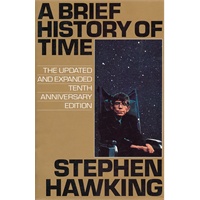
Stephen Hawking, one of the most brilliant theoretical
physicists in history, wrote the modern classic A Brief History of
Time to help nonscientists understand the questions being asked by
scientists today: Where did the universe come from? How and why did
it begin? Will it come to an end, and if so, how? Hawking attempts
to reveal these questions (and where we're looking for answers)
using a minimum of technical jargon. Among the topics gracefully
covered are gravity, black holes, the Big Bang, the nature of time,
and physicists' search for a grand unifying theory. This is deep
science; these concepts are so vast (or so tiny) as to cause
vertigo while reading, and one can't help but marvel at Hawking's
ability to synthesize this difficult subject for people not used to
thinking about things like alternate dimensions. The journey is
certainly worth taking, for, as Hawking says, the reward of
understanding the universe may be a glimpse of "the mind of
God." |
Stephen Hawking, who was born on the anniversary of Galileo's death in 1942, holds Isaac Newton's chair as Lucasian Professor of Mathematics at the University of Cambridge. Widely regarded as the most brilliant theoretical physicist since Einstein, he is also the author of Black Holes and Baby Universes, a collection of essays published in 1993, as well as numerous scientific papers and books. |


 内容加载中,请稍后...





商品评论(0条)