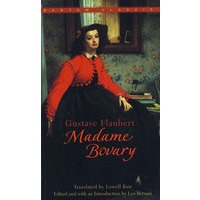
If one were to ask, "World, which is the most perfect novel ever written?," the world would immediately answer: Madame Bovary. There are novels of greater structural complexity, such as Lord Jim and The Good Soldier, or of a broader social canvas, like Anna Karenina and In Search of Lost Time, or of more stylistic dash -- Ulysses, Lolita -- and many far more beloved (Pride and Prejudice, The Great Gatsby, The Leopard), but Madame Bovary still stands as the most controlled and beautifully articulated formal masterpiece in the history of fiction.
Flaubert's artistic sensibility veered most naturally to gaudy excess, not to say a voyeuristic passion for the fleshy, sanguinary and transgressive. A little too much was hardly enough for him. In The Temptation of St. Anthony (three versions, 1849, 1856, 1874), the Queen of Sheba offers herself to the austere saint as a sexual paradise, which she sums up in the quite believable assertion, "I am not a woman, I am a world." Similarly, Salammbo (1862) -- an utterly static novel about ancient Carthage -- presents painterly tableaux of orgy, battle and torture. (I like its overripe sickly-sweetness, but am nearly alone in this taste -- it should have been illustrated by the Delacroix of "The Death of Sardanapalus.") By contrast, Flaubert's most ambitious completed novel, A Sentimental Education (1869) -- a vast social portrait of Paris in the 1840s -- errs in being too dry, too slow-moving, too programmatic. Yet its final pages -- in which the callow Frederic again meets the once-adored but now white-haired Madame Arnoux -- remain among the most honest and disillusioning in all fiction. Only in Madame Bovary (1857) -- and the story "A Simple Heart" (1877) -- did the novelist find just the right style, serene in tone, mildly ironic, tightly organized (partly through the use of unobtrusive symbolism), concise, exact and virtually without stylistic grand-standing. You can shake Madame Bovary and nothing will fall out.
Like certain other classics (The Scarlet Letter, for instance), Flaubert's tale of adultery in the provinces suffers from being a staple of the school curriculum. Generations of French-language students have parsed their way through its paragraphs, noting Emma's future ruination because of her romantic reading and brief glimpse of aristocratic life, speculating about the horse or butterfly symbolism, dissecting the stichomythia of the scene at the country fair where the announcement of agricultural prizes alternates with Rodolphe's honeyed words of seduction. Such linguistic close analysis, which Flaubert invites and rewards, may nonetheless displace attention from an equally important aspect of the novel: its narrative economy and speed. Here is one advantage to reading a translation, particularly a fine one like Margaret Mauldon's: You don't need to pause to look up all those mots justes in a dictionary. Too often students merely work their way through the text with the same grim determination that its author relied on to compose it.
In Madame Bovary Flaubert never allows anything to go on too long; he can suggest years of boredom in a paragraph, capture the essence of a character in a single conversational exchange, or show us the gulf between his soulful heroine and her dull-witted husband in a sentence (and one that, moreover, presages all Emma's later experience of men). Returning from their wedding, the newlyweds and the bridal party must cross a farmer's field:
"Emma's dress was rather long and the hem trailed a bit; from time to time she would stop and lift it up, then, with gloved fingers, delicately remove the wild grasses and tiny thistle burrs, while Charles stood empty-handed, waiting for her to finish."
作者简介:
The great French novelist was born in Rouen in 1821, son of a distinguished surgeon. He studied law briefly, but in 1844 he was struck with epilepsy–it was the first of a series of violent fits that filled Flaubert’s life with apprehension and drove him to lead a hermit’s life. Having been attracted to literature at an early age, he soon turned his entire attention to writing. His first novel, Madame Bovary, won instant fame upon his publication in 1857: Flaubert was sued for “immorality,” but was later acquitted. |




 内容加载中,请稍后...





商品评论(0条)