Charles Darwin was born in Shrewsbury, England, on February
12, 1809--the same day that witnessed the birth of Abraham
Lincoln--into a prominent middle-class family. His mother, who died
when Darwin was eight, was the daughter of the famous potter Josiah
Wedgwood. His father was a wealthy doctor, and his grandfather
Erasmus Darwin had been a celebrated physician and writer whose
books about nature, written in heroic couplets, are often read as
harbingers of his grandson's views. Yet for someone whose
revolutionary writings would turn the scientific world upside down,
Darwin's own youth was unmarked by the slightest trace of genius.
'I believe that I was considered by all my masters and by my Father
as a very ordinary boy, rather below the common standard of
intellect,' he later said. Darwin was an indifferent student and
abandoned his medical studies at Edinburgh University. For years
his one all-consuming passion was collecting beetles. ('I am dying
by inches, from not having any body to talk to about insects,' he
once wrote to a cousin who was likewise obsessed. In 1831 Darwin
graduated with a B.A. from Christ's College, Cambridge, seemingly
destined to pursue the one career his father had deemed
appropriate--that of country parson.
But a quirk of fate soon intervened. John Henslow, a Cambridge
botanist, recommended Darwin for an appointment (without pay) as
naturalist aboard the H.M.S. Beagle, a scientific vessel
commissioned by the Admiralty to survey the east and west coasts of
South America. Among the few belongings Darwin carried with him
were two books that had greatly influenced him at Cambridge:
Charles Lyell's Principles of Geology, which posited radical
changes in the possible estimates of the earth's age, and an
edition of the travel writings of the early nineteenth-century
naturalist Alexander von Humboldt. The Beagle sailed from Plymouth
on December 27, 1831, and returned to England on October 2, 1836;
the around-the-world voyage was the formative experience of
Darwin's life and consolidated the young man's 'burning zeal to add
even the most humble contribution to the noble structure of Natural
Science.'
Darwin devoted the next few years to preparing his 'Transmutation
Notebooks' and writing Journal of Researches into the Geology and
Natural History of the Various Countries Visited by the H.M.S.
Beagle, 1832-1836 (1839) in which his beliefs about evolution and
natural selection first began to take shape. In 1839 he married his
first cousin, Emma Wedgwood. They lived in London until 1842, when
Darwin's chronic ill health forced the couple to move to Down House
in Sussex, where he would spend virtually the rest of his life
working in seclusion. There he soon completed the five-volume work
Zoology of the Voyage of the Beagle (1840-1843) and outlined from
his hoard of notes an early draft of what was eventually to become
The Origin of Species. Over the next decade he also produced a
monograph on coral reefs, as well as extensive studies of
variations in living and fossil barnacles.
In 1856 Sir Charles Lyell persuaded Darwin to write out his
theory of evolution by natural selection, which he had recently
buttressed with ingenious experiments in breeding pigeons. Halfway
through the project, Darwin received an essay from naturalist
Alfred Russel Wallace that presented an identical theory, though
one unsupported by anything comparable to Darwin's massive
accumulation of data. Wracked by doubts and indecision, and fearful
of the controversy his theories might unleash, Darwin nevertheless
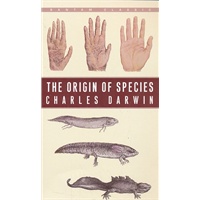
pushed forward to finish The Origin of Species. Published on
November 24, 1859, the book forever demolished the premise that God
had created the earth precisely at 9:00 A.M. on October 23, 4004
B.C.--and that all species of living creatures had been immutably
produced during the following six days--as seventeenth-century
churchmen had so carefully formulated.
Although he did write one sequel and amplification of his theory
of evolution, The Descent of Man (1871), Darwin dedicated most of
his remaining years to botanical studies. Charles Darwin died on
April 19, 1882, following a series of heart attacks. He had wished
to be interred in the quiet churchyard close to the house in which
he had lived and worked for so long, but the sentiment of educated
men demanded a place in Westminster Abbey, where Darwin lies buried
a few feet away from the grave of Isaac Newton. --This text refers
to the Unbound edition.
|



 内容加载中,请稍后...


商品评论(0条)