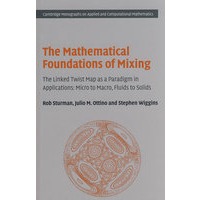
| 作者介绍:Rob Sturnan Rob Sturnan gained his PhD from University College London in 2000. He is currently carrying out research on mixing in microfluidics at the University of Bristol. |
| Acknowledgments 1 Mixing: physical issues 1.1 Length and time scales 1.2 Stretching and folding, chaotic mixing 1.3 Reorientation 1.4 Diffusion and scaling 1.5 Examples 1.5.1 The Aref blinking vortex flow 1.5.2 Samelson's tidal vortex advection model 1.5.3 Chaotic stirring in tidal systems 1.5.4 Cavity flows 1.5.5 An electro-osmotic driven micromixer blinking flow 1.5.6 Egg beater flows 1.5.7 A blinking flow model of mixing of granular materials 1.5.8 Mixing in DNA microarrays 1.6 Mixing at the microscale 2 Linked twist maps: definition, construction and the relevance to mixing 2.1 Introduction 2.2 Linked twist maps on the torus 2.2.1 Geometry of mixing for toral LTMs 2.3 Linked twist maps on the plane 2.3.1 Geometry of mixing for LTMs on the plane 2.4 Constructing a LTM from a blinking flow 2.5 Constructing a LTM from a duct flow 2.6 More examples of mixers that can be analysed in the LTM framework 3 The ergodic hierarchy 3.1 Introduction 3.2 Mathematical ideas for describing and quantifying the flow domain, and a 'blob' of dye in the flow 3.2.1 Mathematical structure of spaces 3.2.2 Describing sets of points 3.2.3 Compactness and connectedness 3.2.4 Measuring the 'size' of sets 3.3 Mathematical ideas for describing the movement of blobs in the flow domain 3.4 Dynamical systems terminology and concepts 3.4.1 Terminology for general fluid kinematics 3.4.2 Specific types of orbits 3.4.3 Behaviour near a specific orbit 3.4.4 Sets of fluid particles that give rise to 'flow structures' 3.5 Fundamental results for measure-preserving dynamical systems 3.6 Ergodicity 3.6.1 A typical scheme for proving ergodicity 3.7 Mixing 3.8 The K-property 3.9 The Bernoulli property 3.9.1 The space of (bi-intinite) symbol sequences, [Sigma superscript N] 3.9.2 The shift map 3.9.3 What it means for a map to have the Bernoulli property 3.10 Summary 4 Existence of a horseshoe for the linked twist map 4.1 Introduction 4.2 The Smale horseshoe in dynamical systems 4.2.1 The standard horseshoe 4.2.2 Symbolic dynamics 4.2.3 Generalized horseshoes 4.2.4 The Conley-Moser conditions …… 5 Hyperbolicity 6 The ergodic partition for toral linked twist maps 7 Ergodicity and the Bernoulli property for toral linked twist maps 8 Linked twist maps on the plane 9 Further directions and open problems References Index |


 内容加载中,请稍后...



商品评论(0条)