最 低 价:¥772.20

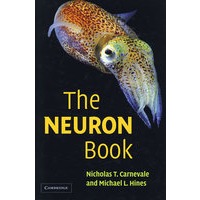
| 作者简介 Nicholas T. Carnevale is Senior Research Scientist in the Department of Psychology at Yale University. He also directs the NEURON courses at the annual meetings of the Society of Neuroscience and the NEURON Summer Courses at the University of California, San Diego and University of Minnesota, Minneapolis. Michael L. Hines is Research Scientist in the Department of Computer Science at Yale University. His work is embodied in a program, NEURON, which enjoys wide use in the experimental and computational neuroscience community. |
| Preface Acknowledgments 1 A tour of the NEURON simulation environment 1.1 Modeling and understanding 1.2 Introducing NEURON 1.3 State the question 1.4 Formulate a conceptual model 1.5 Implement the model in NEURON 1.5.1 Starting and stopping NEURON 1.5.2 Bringing up a CellBuilder 1.5.3 Entering the specifications of the model cell 1.5.3.1 Topology 1.5.3.2 Subsets 1.5.3.3 Geometry 1.5.3.4 Biophysics 1.5.4 Saving the model cell 1.5.5 Executing the model specification 1.6 Instrument the model 1.6.1 Signal sources 1.6.2 Signal monitors 1.7 Set up controls for running the simulation 1.8 Save model with instrumentation and run control 1.9 Run the simulation experiment 1.10 Analyze results References 2 The modeling perspective 2.1 Why model? 2.2 From physical system to computational model 2.2.1 Conceptual model: a simplified representation of a physical system 2.2.2 Computational model: an accurate representation of a conceptual model 2.2.3 An example 3 Expressing conceptual models in mathematical terms 3.1 Chemical reactions 3.1.1 Flux and conservation in kinetic schemes 3.1.2 Stoichiometry, flux, and mole equivalents 3.1.3 Compartment size 3.1.3.1 Scale factors 3.2 Electrical circuits 3.3 Cables References 4 Essentials of numerical methods for neural modeling 4.1 Spatial and temporal error in discretized cable equations 4.1.1 Analytic solutions: continuous in time and space 4.1.2 Spatial discretization 4.1.3 Adding temporal discretization 4.2 Numerical integration methods 4.2.1 Forward Euler: simple, inaccurate and unstable 4.2.1.1 Numerical instability 4.2.2 Backward Euler: inaccurate but stable 4.2.3 Crank-Nicholson: stable and more accurate 4.2.3.1 Efficient handling of nonlinearity 4.2.4 Adaptive integration: fast or accurate,occasionally both 4.2.4.1 hnplementational considerations 4.2.4.2 The user's perspective 4.2.4.3 Local variable time step method 4.2.4.4 Discrete event simulations 4.3 Error 4.4 Summary of NEURON's integration methods 4.4.1 Fixed time step integrators 4.4.1.1 Default: backward Euler 4.4.1.2 Crank-Nicholson 4.4.2 Adaptive integrators …… 5 Representing neurons with a digital digital computer 6 How to build and use models of individual cells 7 How to control simulations 8 How to initialize simulations 9 How to expand NEURON's library of mechanisms 10 Synaptic transmission and artificial spiking cells 11 Modeling networks 12 hoc,NEURON's interpreter 13 Object-oricnted programming 14 How to modify NEURON itself Appendix A1 Mathematical analysis of IntFire4 Appendix A2 NEURON's buist-in editor References Epilogue Index |





 内容加载中,请稍后...


商品评论(0条)