最 低 价:¥643.50

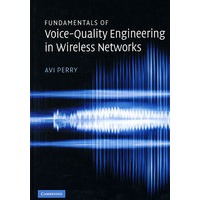
| Dr Avi Perry, a key contributor to the ITU-T G.168 standard, is currently an independent consultant. He was Vice President at NMS Communications, where he was responsible for core technology, system engineering, competitive analysis, documentation, and technical support. He has also held positions at Lucent Technologies and Bell Laboratories and the Northwestern University Graduate School of Management. |
| Preface List of abbreviations Introduction Plan of the book Part Ⅰ Voice-quality foundations 1 An overview of voice-coding architectures in wireless communications 1.1 Introduction 1.2 Pulse-code modulation 1.3 Wireless codecs 1.4 Summary 1.5 Transmission media 1.6 Audio illustrations 2 Quantitative assessment of voice quality 2.1 Introduction 2.2 Measuring and quantifying voice quality 2.3 Relating voice-quality metrics to perceived worth 2.4 Mean opinion scores of wireless codecs 2.5 Standard computerized tools for speech-quality assessment Part Ⅱ Applications 3 Electrical echo and echo cancelation 3.1 Electrical echo 3.2 Echo in wireless and long-distance networks 3.3 Echo control 3.4 Placement in the network 3.5 Convergence and adaptation processes 3.6 Tail delay and its impact on performance 3.7 Far-end echo cancelation 3.8 Background music-music on hold 3.9 Voice-response systems-barging 3.10 Hot signals 3.11 Voice-band data and fax 3.12 Signaling systems nos. 5, 6, and 7 3.13 Conclusions 4 Acoustic echo and its control 4.1 Introduction 4.2 Round-trip delay and echo dispersion 4.3 Reasons for perceiving acoustic echo in wireless communications 4.4 Controlling acoustic echo in digital-wireless networks-main considerations 4.5 Acoustic-echo activity detection 4.6 Residual acoustic-echo control in the frequency domain 4.7 The impact of comfort-noise matching on the performance-Of acoustic-echo control 4.8 Correcting impairments caused by some acoustic-echo control algorithms built into mobile handsets 4.9 Network topology of acoustic-echo control 4.10 Conclusions 5 Noisy ambience, mobility, and noise reduction 5.1 Noise in wireless networks 5.2 Introduction to noise reduction 5.3 The noise-reduction process 5.4 Noise reduction and GSM DTX 5.5 Noise reduction and CDMA EVRC and SMV codecs 5.6 Noise-reduction level compensation 5.7 Noise reduction and signals other than voice 5.8 Network topology of noise reduction 6 Speech-level control 6.1 Introduction 6.2 Basic signal-level measurements and definitions 6.3 Automatic level control (ALC) 6.4 Noise compensation (NC) 6.5 Combined NC and ALC 6.6 High-level compensation …… Part Ⅲ Wireless architectures Part Ⅳ A network operator's guide for selecting, appraising, and testing a VQS Part Ⅴ Managing the network Part Ⅵ Afterthoughts and some fresh ideas Part Ⅶ Recordings |


 内容加载中,请稍后...


商品评论(0条)