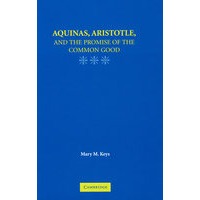
| 作者简介:Mary M. Keys is assistant professor of political science at the University of Notre Dame. She has received fellowships from the Erasmus Institute, University of Notre Dame; the Martin Marty Center for Advanced Study of Religion at the University of Chicago, and the George Strake Foundation, among others. Her articles have appeared in American Journal of Political Science and History of Political Thought. |
| Acknowledgments PART Ⅰ: VIRTUE, LAW, AND THE PROBLEM OF THE COMMON GOOD 1 Why Aquinas? Reconsidering and Reconceiving the Common Good 1.1 The Promise and Problem of the Common Good: Contemporary Experience and Classical Articulation 1.2 Why Aquinas? Centrality of the Concept and Focus on Foundations 1.3 An Overview of the Argument by Parts and Chapters 2 Contemporary Responses to the Problem of the Common Good: Three Anglo-American Theories 2.1 Liberal Deontologism: Contractarian Common Goods in Rawls Theory of justice 2.2 Communitarianism or Civic Republicanism: Sandel against Commonsense "Otherness" 2.3 A Third Way? Galston on the Common Goods of Liberal Pluralism PART Ⅱ: AQUINAS'S SOCIAL AND CIVIC FOUNDATIONS 3 Unearthing and Appropriating Aristotle's Foundations: From Three Anglo-American Theorists Back to Thomas Aquinas 3.1 Aristotelianism and Political-Philosophic Foundations, Old and New 3.2 Aristotle's Three Political-Philosophic Foundations in Thomas Aquinas's Thought 3.3 The First Foundation and Aquinas's Commentary: Human Nature as "Political and Social" in Politics I 4 Reinforcing the Foundations: Aquinas on the Problem of Political Virtue and Regime-Centered Political Science 4.1 The Second Foundation and Aquinas's Commentary: Human Beings and Citizens in Politics 4.2 Faults in the Foundations: The Uncommented Politics and the Problem of Regime Particularity 4.3 Politics Pointing beyond the Polis and the Politeia: Aquinas's New Foundations 5 Finishing the Foundations and Beginning to Build: Aquinas on Human Action and Excellence as Social, Civic, and Religious 5.1 Community, Common Good, and Goodness of Will 5.2 Natural Sociability and the Extension of the Human Act 5.3 Cardinal Virtues as Social and Civic Virtues — with a Divine Exemplar PART Ⅲ: MORAL VIRTUES AT THE NEXUS OF PERSONAL AND COMMON GOODS 6 Remodeling the Moral Edifice (I): Aquinas and Aristotelian Magnanimity 6.1 Aristotle on Magnanimity as Virtue 6.2 Aquinas's Commentary on the Magnanimity of the Nicomachean Ethics 6.3 The Summa Theologiae on Magnanimity and Some "Virtues of Acknowledged Dependence" 7 Remodeling the Moral Edifice (II): Aquinas and Aristotelian Legal Justice 7.1 Aristotle on Legal Justice 7.2 Aquinas's Commentary on Legal Justice in the Nicomachean Ethics 7.3 Legal Justice and Natural Law in the Summa Theologiae PART Ⅳ: POLITICS, HUMAN LAW, AND TRANSPOLITICAL VIRTUE 8 Aquinas's Two Pedagogies: Human Law and the Good of Moral Virtue 8.1 Aquinas's Negative Narrative, or How Law Can Curb Moral Vice 8.2 Beyond Reform School: Law's Positive Pedagogy According to Aquinas 8.3 Universality and Particularity, Law and Liberty 8.4 Thomistic Legal Pedagogy and Liberal-Democratic Polities …… Works Cited Index |
 内容加载中,请稍后...







商品评论(0条)