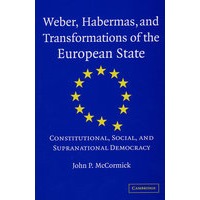
| 作者简介 John P. McCormick is professor of political science at the University of Chicago. From 1998 to 2003, he taught political theory at Yale University. He has received several fellowships, grants, and awards, including a Fulbright to the Center for European Law & Politics at the University of Bremen in Germany and a Monnet at the European University Institute in Florence, Italy. Professor McCormick is the author of Carl Schmitt's Critique of Liberalism: Against Politics as Technology(Cambridge, 1997) and the editor of Confronting Mass Democracy and Industrial Technology: German Political and Social Thought from Nietzsche to Habermas(2002). He has published numerous articles on 20th-century continental legal-political theory and Renaissance political and constitutional thought in scholarly journals such as the American Political Science Review(1992, 1999, 2001, 2006) and Political Theory(1994, 1998, 2001, 2003). |
| Acknowledgments Abbreviations 1 Introduction: Theorizing Modern Transformations of Law and Democracy 1 . Critical Theory and Structural Transformations 2. Critical Theory and the Supranational Constellation 3. Chapter Outline 4. Law, Democracy, and State Transformation Today 2, The Historical Logic(s) of Habermas's Critique of Weber's "Sociology of Law" 1. The Fragility of Legal-Rational Legitimacy 2. Moral Underpinnings of Formal Law 3. The Possibility of Rationally Coherent Sozialstaat Law 4. Secularization, Commodification, and History Excursus: The Transformation of Habermas's Theory of History 5. Philosophy of History and the Sociology of Law Conclusion 3 The Puzzle of Law, Democracy, and Historical Chang in Weber's "Sociology of Law" 1. The Public-Private Law Distinction and "Modern" Law 2. History as Confirmation/Contestation of Legal Categories 3. Legal History as Contrast/Continuity with the Present 4. Legal Limits on Power: Separation and Application 5. Organizations, Special Law, and the Law of the Land 6. Weber, Law, and Social Change 7. Formal and Substantive Rationalization of Law 8. Formal versus Substantive Law and the Sozialstaat Conclusion 4 Habermas's Deliberatively Legal Sozialstaat: Democracy,Adjudication, and Reflexive Law 1. Habermas on Language and Law, Lifeworld and System 2. Beyond Formalist and Vitalist Notions of Constitutional Democracy 3. Rational and Democratically Accessible Adjudication 4. Selecting Nineteenth- or Twentieth-Century Paradigms of Law 5. Conceptual Paradigms and Historical Configurations o fLaw Conclusion 5 Habermas on the EU: Normative Aspirations, Empirical Questions, and Historical Assumptions 1. Global Problems to Be Solved by EU Democracy 2. The History of the State as a Guide to the Present 3. The Form and Content of EU Democracy 4. Critical-Historical Limits of Habermas's Theory of E U Democracy Conclusion 6 The Structural Transformation to the Supranational Sektoralstaat and Prospects for Democracy in the EU 1. Legal Integration and the Supranationalist Model 2. State Centrism - E U Law Constrained 3. The European Sektoralstaat Model 4. Democracy, the EU Sektoralstaat, and Further Questions 7 Conclusion: Habermas's Philosophy of History and Europe's Future Index |
 内容加载中,请稍后...







商品评论(0条)