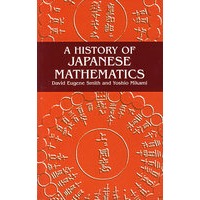
One of the first books to show Westerners the nature of Japanese mathematics, this survey highlights the leading features in the devel-opment of the wasan, the Japanese system of mathematics. Its distin-guished co-authors are the Japanese mathematical historian Yoshio Mikami and David Eugene Smith, an American who was instrumental in the founding of an international commission that compared the effectiveness of teaching methods from around the world.
The text traces the development of wasan from its earliest period to the introduction of Western mathematics. Topics include the use of the soroban, or abacus; the application of sangi, or counting rods, to algebra; and the discoveries of the seventeenth-century sage, Seki K6wa, who is regarded as the founder of Japanese mathematics. In addition to its discussions of Seki's contemporaries and their possi-ble Western influences, the text explores the yenri, or circle principle;the work of eighteenth-century geometer Ajima Chokuyen, who invented methods more sophisticated than those of Archimedes for calculating lengths of arcs of circles; and Wada Nei's contributions to the understanding of hypotrochoids. |


 内容加载中,请稍后...




商品评论(0条)