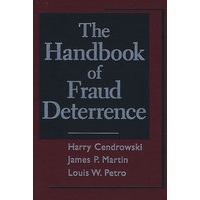
| Harry Cendrowski, a frequent speaker on forensic accounting and litigation, is author of NACVA training programs and many journal articles. He is President of Cendrowski Corporate Advisors that produces two newsletters on fraud: The Fraud Files and Corporate Governance Edition. |
| List of Exhibits Preface Acknowledgments SECTION I PROFESSIONAL ENVIRONMENT OF FRAUD DETERRENCE 1 Fraud Deterrence as a Business Management Tool Introduction Motivations for Process Improvement and Monitoring How the Mighty Have Fallen Importance of Internal Controls in Dynamic External Environments Environmental Change and Its Effect on the Fraud Triangle Where Is Bedrock for Fraud Deterrence? Conclusion 2 Definition of Fraud Deterrence Overview Deterrence Activities Will Affect Control Culture 3 History of Fraud Deterrence Introduction Early Fraud Deterrence Modern Fraud Deterrence 4 The Role of Professional Standards Introduction PCAOB Standards American Institute of Certified Public Accountants Auditing Standards American Institute of Certified Public Accountants Accounting and Review Standards Institute of Internal Auditors Standards Association of Certified Fraud Examiners Standards Certified Fraud Deterrence Analyst—National Association of Certified Valuation Analysts 5 The Fraud Triangle Overview Elements The Fraud Triangle and Financial Reporting Fraud 6 Motivations of Fraud Deterrence and the Transition to Investigation Introduction Motivations for Deterrence Analysis Transition to Investigation Conclusion 7 A Fraud Deterrence Professional’s Overview of the Legal Process Introduction and Objectives Basics of Opinion Testimony and the Role of the Judiciary Expert Qualification Standards : When Is a Witness an “Expert”? Admissibility versus Weight: When Is an Expert’s Opinion and/or Testimony Admissible? Limitations on the Scope of Expert Opinion Testimony Reports and Discovery Obligations Conclusion 8 Human Resources Concerns Retaliation: The Newest Wave of Employment Litigation An Ounce of Prevention: Background Checks and Employment Inquiries Under the Fair Credit Reporting Act Checklist for Complying with the FCRA When Using a Third Party to Obtain “Consumer Reports." Conclusion Appendix 8A Selected Federal Whistleblower Statutes Appendix 8B The U.SEqual Employment Opportunity Commission Appendix 8C Disclosure to Applicant Regarding Consumer Reports Appendix 8D Disclosure to Employee Regarding Consumer Reports Appendix 8E Sample Notice of Intent to Obtain an Investigative Consumer Report Appendix 8F Fair Credit Reporting Act Appendix 8G Sample Disclosure of Nature and Scope of Investigative Consumer Report Appendix 8H Sample Pre-Adverse Action Notice Appendix 8I Sample Adverse Action Notice Appendix 8J Applicant Appendix 8K Current Employee SECTION II TOOLS OF FRAUD DETERRENCE 9 Internal Control and Fraud Deterrence: The COSO Integrated Framework Background Control Environment Information and Communication Risk Assessment Control Procedures Monitoring 10 Recent Corporate Governance Reforms Enacted to Deter Financial Fraud The Sarbanes-Oxley Act of 2002 and Related Rules and Regulations Introduction Board of Directors Audit Committee Management Internal Auditors Enforcement Protections for Directors and Officers Conclusion 11 Generation-X Technologies and Information Assurance Overview Do We Need a Paradigm Shift in Systems Assurance and Auditing? Generation X Enterprise Technologies: State of the Art Information Systems Integration: A Challenge Assured Information Emanates from Assured Systems Information Assurance: A Function of Strategic Importance Various Information Assurance and Control Measures British Standards: BS7799 and BS 7799-2:2002 System Security Engineering Capability Maturity Model: SSE-CMM Conclusion 12 The Impact of Communications Infrastructure on Fraud Detection and Deterrence Introduction Fraud and Technology Communication Security Solutions Correlation 13 Process and Information Validation Part I: Interview and Interrogation Process Difference between Interview and Interrogation Preparation and Room Setting Interviewer/Interrogator Demeanor Detecting Deception Conducting the Interview Interrogation Structured Approach to the Interview and Interrogation of a Suspect in a Fraud Investigation Conclusion Part II: Forensic Document and Handwriting Examination What Is a “Document”? Forgery Red Flags of Document Examination Caution Red Flags of Handwriting Identification Suggested Reading 14 Data Analysis and Monitoring: How Effective Data Analysis Can Identify Fraud Risk Indicators and Promote Business Intelligence Introduction Data Basics Information Systems Generating Business Intelligence What to Look for in Data Analysis Technology Putting It All Together 15 Reporting Introduction Function of Fraud Deterrence Reports Reporting on Internal Control Reporting in an Investigation Importance of Documentation Conclusion SECTION III APPLICATIONS OF FRAUD DETERRENCE 16 Deterring Fraudulent Financial Reporting and Asset Misappropriation Introduction Organizational (Corporate) Culture Organizational (Corporate) Governance Internal Controls for Deterrence Deterrence Monitoring 17 Fraud and the Bankruptcy Code Introduction Bankruptcy Refuge for Fraudulent Actors Bankruptcy Fraud Fraudulent Transfer Statutes Intentionally Fraudulent Transfers Constructively Fraudulent Transfers Application of Fraudulent Transfer Laws Remedies for the Recovery of Fraudulent Transfers Corporate Actors/Individual Liability Conclusion Appendix 17A Uniform Fraudulent Conveyance Act and Uniform Fraudulent Transfer Act Appendix 17B Uniform Fraudulent Conveyance Act Appendix 17C Uniform Fraudulent Transfer Act Appendix 17D 18 U.S.C§§ 152–157 Appendix 17E 11 U.S.C§ 548Fraudulent Transfers and Obligations Appendix 17F 11 U.S.C§ 522 Exemptions Appendix 17G 11 U.S.C§ 101(31)Definitions 18 Discovering and Preventing Fraud in Business Formation and Dissolution Introduction Fundamental Assessments Factors Affecting Whether the Fraud Will Succeed Informational Rights and Fraud Approval Rights and Governance Additional Drafting Solutions Minimizing the Occurrence of Fraud Discovery of Fraud Remedies 19 Identity Theft and Privacy Protection Introduction Definition Development of an Epidemic The Outbreak and Law Enforcement Protecting Personal Information Detect Unauthorized Use Defend and Regain Your Identity Bulk Data Breaches The Online Frontier of Phishing and Spoofing Impact on Fraud Deterrence 20 Intellectual Property Introduction How to Tell When Your Company Has Intellectual Property Basic Reasons for Protecting Routine Protection Policing Intellectual Property Rights Possible Recoveries through Litigation Conclusion 21 Fraud Deterrence in the U.SPrivate Equity Finance System Introduction U.SPrivate Equity System and Its Governance Structure Foundations of a Fraud Deterrence System in Private Equity Adoption of Internal Control Systems within the U.SPrivate Equity System Conclusions and Recommendations Glossary of Terms Index |

 内容加载中,请稍后...



商品评论(0条)