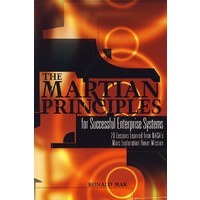
| 作者简介: Ronald Mak was a senior computer scientist and software architect at the NASA Ames Research Center. He was the architect and lead developer of the middleware for the Collaborative Information Portal, an important enterprise software system that is a part of NASA’s ongoing and highly successful Mars Exploration Rover mission. Mission managers, scientists, and engineers continue to use CIP—after over two years of continuous operation, it has an uptime record of better than 99.9 percent. Working as a key member of the CIP development teamvalidated the principles that Ron describes in this book.Ron was also the architect and lead developer of an enterprise class information portal for NASA’s International Space Station and the future Crew Exploration Vehicle. Prior to joining NASA, Ron had over 15 years of experience designing and developing enterprise systems using several programming languages and technologies on various platforms. Most of these systems were highly successful, but therewere a few failures, too. The Martian principles are derivedfrom these experiences. Ron held an academic appointment with the University of California at Santa Cruz, and he worked on contract to NASAAmes. He earned his B.S. degree with distinction in the Mathematical Sciences and his M.S. degree in Computer Science from Stanford University. He has written three previous books on computer science, Java Number Cruncher, the Java Programmer’s Guide to Numerical Computing (Prentice Hall PTR, 2003), Writing Compilers and Interpreters, C++ Edition (Wiley, 1996), and Writing Compilers and Interpreters, a Practical Approach (Wiley, 1991). He recently wrote several papers about CIP for refereed journals. He continues to hone his exposition of the Martian principles by giving presentations to both industry and academic audiences. Ron recently co-founded and is the CTO of Willard & Lowe Systems, Inc. (www.willardlowe.com) which develops enterprise systems for information management and collaboration. |
| About the Author Preface Acknowledgments Introduction Part 1 The Martian Principles Principle 1 Don’t reinvent the wheel Principle 2 You won’t do better than what’s already been done Principle 3 Your customers don’t know what they want Principle 4 Get something working as soon as possible Principle 5 Use sound software engineering practices Principle 6 Don’t trust the client applications Principle 7 Plan to make changes Principle 8 You can’t predict the future Principle 9 Don’t tie your services into knots Principle 10 Build early, build often! Principle 11 “What middleware?” should be your greatest compliment Principle 12 Expose the invisible Principle 13 Log everything Principle 14 Know the data Principle 15 Know when it will break Principle 16 Don’t fail due to unexpected success Principle 17 Strong leadership drives a project to success Principle 18 Don’t ignore people issues Principle 19 Software engineering is all about the D’s Principle 20 The formulas for success aren’t complicated Index |




 内容加载中,请稍后...



商品评论(0条)