网上购物 货比三家
您现在的位置:快乐比价网 > 图书 > 教育/科技 > 科学与研究 > 商品详情

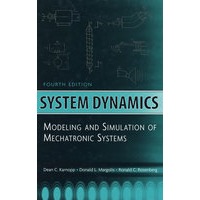
System dynamics系统动力学:机电系统建模与模拟

分享到:
System dynamics系统动力学:机电系统建模与模拟

最 低 价:¥949.50

定 价:¥1266.00

作 者:Dean C. Karnopp,Donald L. Margolis,Ronald C. Rosenberg 著

出 版 社:吉林长白山

出版时间:2006-1-1

I S B N:9780471709657

商品详情

编辑推荐

内容简介

A revision of the bestselling system dynamics book using the bond graph approach
  System Dynamics is a cornerstone resource for engineers faced with the evermore-complex job of designing mechatronic systems involving any number of electrical, mechanical, hydraulic, pneumatic, thermal, and magnetic subsystems. This updated Fourth Edition offers the latest coverage on one of the most important design tools today-bond graph modeling-the powerful, unified graphic modeling language.
  The only comprehensive guide to modeling, designing, simulating, and analyzing dynamic systems comprising a variety of technologies and energy domains, System Dynamics, Fourth Edition continues the previous edition's step-by-step approach to creating dynamic models. The first six chapters have been improved to make the material much more understandable for those unfamiliar with physical system modeling. The presentation starts with the basic elements and leads to sophisticated mathematical models suitable for automated computer simulation. The new edition incorporates the authors' vast experience in teaching the topics to undergraduate and graduate students over many years and features expanded coverage of topics including:
  New expositions of modeling methods for electrical, mechanical, and hydraulic systems
  New sections on mechanical systems in plane and three-dimensional motion
  New sections on hydraulic and acoustic systems
  This Fourth Edition continues to stress all the essentials-from basic hand formulation of simple bond graph models to the automatic simulation of complex mechatronic systems. It offers updated examples of multi-energy domain systems as well as:
  Discussions of state-of-the-art simulation software for use with bond graph models;
  Presentations of a multiport modeling philosophy based on power and energy interactions;
  Methods for understanding system characteristics and predicting system behaviors;
  The use of graphical depictions of dynamic systems that can be translated automatically into complex mathematical models for computer simulation.
  作者简介:
  DEAN C. KARNOPP and DONALD L. MARGOLIS are Professors of Mechanical Engineering at the University of California, Davis.
RONALD C. ROSENBERG is Professor of Mechanical Engineering at Michigan State University.

作者简介

目录

Preface
1 Introduction
 1.1 Models of Systems
 1.2 Systems Subsystems and Components
 1.3 State-Determined Systems
 1.4 Uses of Dynamic Models
 1.5 Linear and Nonlinear Systems
 1.6 Automated Simulation
 References
 Problems
2 Multiport Systems and Bond Graphs
 2.1 Engineering M~ltiports
 2.2 Ports Bonds and Power
 2.3 Bond Graphs
 2.4 Inputs Outputs and Signals
 Problems
3 Basic Component Models
 3.1 Basic 1-Port Elements
 3.2 Basic 2-Port Elements
 3.3 The 3-Port Junction Elements
 3.4 Causality Considerations for the Basic Multiports
  3.4.1 Causality for Basic !-Ports
  3.4.2 Causality for Basic 2-Ports and 3-Ports
 3.5 Causality and Block Diagrams
3.6 Pseudo-Bond Graphs and Thermal Systems
Reference
Problems
4 System Models
 4.1 Electrical Systems
  4.1.1 Electrical Circuits
  4.1.2 Electrical Networks
 4.2 Mechanical Systems
  4.2.1 Mechanics of Translation
  4.2.2 Fixed-Axis Rotation
  4.2.3 Plane Motion
 4.3 Hydraulic and Acoustic Circuits
  4.3.1 Fluid Resistance
  4.3.2 Fluid Capacitance
  4.3.3 Fluid Inertia
  4.3.4 Fluid Circuit Construction
  4.3.5 An Acoustic Circuit Example
 4.4 Transducers and Multi-Energy-Domain Models
  4.4.1 Transformer Transducers
  4.4.2 Gyrator Transducers
  4.4.3 Multi-Energy-Domain Models
 References
 Problems
5 State-Space Equations and Automated Simulation
 5.1 Standard Form for System Equations
 5.2 Augmenting the Bond Graph
 5.3 Basic Formulation and Reduction
 5.4 Extended Formulation Methods--Algebraic Loops
  5.4.1 Extended Formulation Methods--Derivative Causality
 5.5 Output Variable Formulation
 5.6 Automated and Nonlinear Simulation
  5.6.1 Nonlinear Simulation
  5.6.2 Automated Simulation
 Reference
 Problems
6 Analysis of Linear Systems
 6.1 Introduction
 6.2 Solution Techniques for Ordinary Differential Equations
 ……
7 Multiport Fields and Junction Structures
8 Transducers,Amplifiers,and Instruments
9 Mechanical Systems with Nonlinear Geometry
10 Distrbuted-Parameter Systems
11 Magnetic Circuits and Devices
12 Thermofluid Systems
13 Nonlinear System Simulation
Appendix
Index

商品评论(0条)

暂无评论!

您的浏览历史

loading 内容加载中,请稍后...