最 低 价:¥795.20

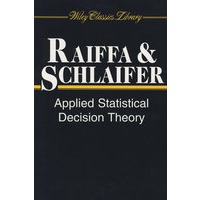
| Foreword Preface and Introduction Part I: Experimentation and Decision: General Theory 1. The Problem and the Two Basic Modes of Analysis 1. Description of the Decision Problem 1: The basic data; 2: Assessment of probability measures; 3: Example; 4: The general decision problem as a game. 2. Analysis in Extensive Form 1: Backwards induction; 2: Examplc. 3. Analysis in Normal Form 1: Decision rules; 2: Performance, error, and utility characteristics; 3:Ex-ample; 4: Equivalence of the extensive and normal form; 5: Bayesian deci- sion theory as a completion of classical theory; 6: Informal choice of a decision rule. 4. Combination of Formal and Informal Analysis 1: Unknown costs; cutting the decision tree; 2: Incomplete analysis of the decision tree; 3: Example. 5. Prior Weights and Consistent Behavior 2. Sufficient Statistics and Noninformative Stopping 1. Introduction 1: Simplifying assumptions; 2: Bayes' theorem; kernels 2. Sufficiency 1: Bayesian definition of sufficiency; 2: Identification of sufficient statistics; 3: Equivalence of the Bayesian and classical definitions of sufficiency; 4: Nuisance parameters and marginal sufficiency. 3. Noninformative Stopping 1: Data-generating processes and stopping processes; 2: Likelihood of a sample; 3: Noninformative stopping processes; 4: Contrast between the Bayesian and classical treatments of stopping; 5: Summary. 3. Conjugate Prior Distributions 1. Introduction; Assumptions and Definitions 1: Desiderata for a family of prior distributions; 2: Sufficient statistics of fixed dimensionality. 2. Conjugate Prior Distributions 1: Use of the sample kernel as a prior kernel; 2: The posterior distribution when the prior distribution is natural-conjugate; 3: Extension of the domain of the parameter; 4: Extension by introduction of a new parameter; 5: Con- spectus of natural-conjugate densities. 3. Choice and Interpretation of a Prior Distribution 1: Distributions fitted to historical relative frequencies; 2: Distributions fitted to subjective betting odds; 3: Comparison of the weights of prior and sample evidence; 4: "Quantity of information" and "vague" opinions; 5: Sensitivity analysis; 6: Scientific reporting. 4. Analysis in Extensive Form when the Prior Distribution and Sample Likelihood are Conjugate 1: Definitions of terminal and preposterior analysis; 2: Terminal analysis; 3: Preposterior analysis. Part II: Extensive-Form Analysis When Sampling and Terminal Utilities Are Additive 4. Additive Utility, Opportunity Loss, and the Value of Information:Introduction to Part II 1. Basic Assumptions 2. Applicability of Additive Utilities 3. Computation of Expected Utility 4. Opportunity Loss 1: Definition of opportunity loss; 2: Extensive-form analysis using oppor-tunity loss instead of utility; 3: Opportunity loss when terminal and sam- piing utilities are additive; 4: Direct assessment of terminal opportunity losses; 5: Upper bounds on optimal sample size. 5. The Value of Information l: The value of perfect information; 2: The value of sample information and the net gain of sampling; 3: Summary of relations among utilities, op- portunity losses, and value of information. 5A. Linear Terminal Analysis 1. Introduction 1: The transformed state description co; 2: Terminal analysis. 2. Expected Value of Perfect Information when w is Scalar 1: Two-action problems; 2: Finite-action problems; 3: Evaluation of linear- loss integrals; 4: Examples. 3. Preposterior Analysis 1: The posterior mean as a random variable; 2: The expected value of sam- ple information. 4. The Prior Distribution of the Posterior Mean for Given e 1: Mean and variance of ~"; 2: Limiting behavior of the distribution; 3 Limiting behavior of integrals when is scalar; 4: Exact distributions of; 5: Aouroximations to the distribution of : 6: Examt)les. …… part III:Distribution Theory |




 内容加载中,请稍后...


商品评论(0条)