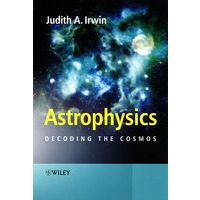
| Preface Acknowledgments Introduction Appendix: dimensions, units and equations PART I THE SIGNAL OBSERVED 1 Defining the signal 1.1 The power of light - luminosity and spectral power 1.2 Light through a surface - flux and flux density 1.3 The brightness of light - intensity and specific intensity 1.4 Light from all angles - energy density and mean intensity 1.5 How light pushes - radiation pressure 1.6 The human perception of light - magnitudes 1.7 Light aligned - polarization Problems 2 Measuring the signal 2.1 Spectral filters and the panchromatic universe 2.2 Catching the signal – the telescope 2.3 The Corrupted signal – the atmosphere 2.4 Processing the signal 2.5 Analysing the signal 2.6 Visualizing the signal Problems Appendix: refraction in the Earth’s atmosphere PART II MATTER AND RADIATION ESSENTIALS 3 Matter essentials 3.1 The Big Bang 3.2 Dark and light matter 3.3 Abundances of the elements 3.4 The gaseous universe 3.5 The dusty Universe 3.6 Cosmic rays Problems Appendix: the electron/proton ratio in cosmic rays 4 Radiation essentials 4.1 Black body radiation 4.2 Grey bodies and planetary temperatures Problems Appendix: derivation of the Planck function 4.A.1 The statistical weight 4.A.2 The mean energy per state 4.A.3 The specific energy density and specific intensity PART III THE SIGNAL PERTURBED 5 The interaction of light with matter 6 The signal transferred 7 The interaction of light with space PART IV THE SIGNAL EMITTED 8 Continuum emission 9 Line emission PART V THE SIGNAL DECODED 10 Forensic astronomy Appendix A: Mathematical and geometrical relations Appendix B: Astronomical geometry Appendix C: The hydrogen atom Appendix D: Scattering processes Appendix E: Plasmas, the plasma frequency, and plasma waves Appendix F: The Hubble relation and the expanding Universe Appendix G: Tables and Figures References Index |


 内容加载中,请稍后...



商品评论(0条)