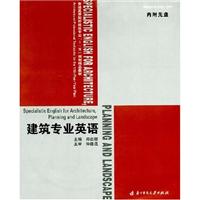
| 《建筑专业英语》(附盘)设有中文导读,阅读查找方便;书后附专业术语中英文解释;光盘部分案例丰富,附大量图片。因此,本书适用于普通高等院校建筑类、城市规划类及环境艺术类、设计类等院系使用,也可供建筑师、城市规划师、景观设计师以及相关从业人员阅读参考。 |
| SECTION 1: ARCHITECTURE1.1 Form Composition 1.1.1 Transformation and Deformation1.1.2 The Modulor1.1.3 Geometry1.1.4 After Geometry1.2 Visual Thinking1.2.1 Introduction1.2.2 The Uses of Visual Notes1.2.3 A Guide to Visual Note-taking1.2.4 Visual Literacy1.3 Design Process1.3.1 Predesign1.3.2 General Design Process1.3.3 Postdesign1.3.4 Interviews1.4 Great Architects and Their Masterpieces1.4.1 Zaha Hadid—Space for Art 1.4.2 Venturi House1.4.3 An Introduction to Foster's Projects1.4.4 Gehry House 1.5 Comments on Architectural Design1.5.1 Light and Gravity 1.5.2 Bigness1.5.3 The Architect's Conscience(Ⅰ)1.5.4 The Architect's Conscience(Ⅱ)1.6 Trends in Modern Architecture1.6.1 Modem Architecture Conservation1.6.2 Globalization versus Localization--Contemporary Architecture and the Arab City 1.6.3 Combining Functional High-tech Aesthetic Experimentation1.6.4 Advanced Technology and the Indeterminate ProgramSECTION 2: URBAN PLANNING AND DESIGN2.1 Theory of Urban Planning2.1.1 What is a City? 2.1.2 Urban and Region 2.1.3 What is Planning Theory?2.1.4 Urbanism as away of Life2.2 English Planning System2.2.1 Creating Better Places to Live--A Guide to the Planning System in U.K.2.2.2 The Nature of Planning--Conflict and Disputes2.2.3 New Towns2.2.4 Level of Involvement2.3 American Planning2.3.1 Zoning Introduction2.3.2 Zoning of New York2.3.3 Urbanization and Suburbanization2.3.4 The Future of Cities and Cities of the Future2.4 Introduction to Urban Design2.4.1 Urban Public Space2.4.2 Ten Principles for Creating Successful Squares2.4.3 Magic in the Motor City2.4.4 What is Urban Design?2.5 Community Planning2.5.1 Creating Community Places: An Antidote to Sprawl2.5.2 Finding a Place for Parking2.5.3 Using Consultants for Community Comprehensive Planning 2.5.4 Reinvent Community Planning2.6 Site Planning 2.6.1 Sustainable Site Design 2.6.2 Site Selection 2.6.3 Natural Characteristics 2.6.4 Technology and InnovationSECTION 3:LANDSCAPE DESIGN3.1 An Introduction to Landscape Architecture3.1.1 Landscape as a System3.1.2 Basic Principles of Landscape Design3.1.3 What Composes the Feature of the City?3.1.4 The Modernist Landscape3.2 Public Landscape3.2.1 The Street in European Cities3.2.2 The Enclosed Square3.2.3 Creating More Comfortable Parks and Plazas3.2.4 The Openness of Open Space3.3 Several Styles of Landscape3.3.1 English Gardens3.3.2 Japanese Gardens3.3.3 Minimalist Landscape3.3.4 Classical Chinese Gardens: Development and Classification3.4 Landscape Design3.4.1 The Foundation for Designing(Ⅰ)3.4.2 The Foundation for Designing(Ⅱ)3.4.3 Devices3.4.4 Interview with Ronald Gregory3.5 Parks and Recreation3.5.1 Large City Parks3.5.2 Small Urban Parks3.5.3 Outdoor Play Areas3.5.4 The Park System in Maricopa County3.6 Landscape Elements3.6.1 Landscape Planting Design Criteria3.6.2 About Water3.6.3 Street Furnishings3.6.4 PavingKeysTerms |


 内容加载中,请稍后...




商品评论(0条)