最 低 价:¥225.30

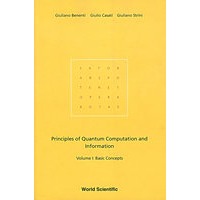
| 作者介绍Giuliano Benenti: Giuliano Benenti. Born in Voghera (Pavia), Italy,November 7, 1969. He is a researcher in Theoreti-cal Physics at Universita dell' Insubria, Como. He re-ceived his Ph.D. in physics at Universita di Milano, Italyand was a postdoctoral fellow at CEA, Saclay, France.His main research interests are in the fields of classicaland quantum chaos, open quantumsystems,mesoscopicphysics, disordered systems, phase transitions, many-body systems and quantuminformationtheory.Readership: Undergraduates, physicists, electronic engineers, biologists and life-scientists interested in basic computational nano-engineering. |
| Preface Introduction Introduction to Classical Computation 1.1 The Turing machine 1.1.1 Addition on a Turing machine 1.1.2 The Church-Turing thesis 1.1.3 The universal Turing machine 1.1.4 The probabilistic Turing machine 1.1.5 The halting problem 1.2 The circuit model of computation 1.2.1 Binary arithmetics 1.2.2 Elementary logic gates 1.2.3 Universal classical computation 1.3 Computational complexity 1.3.1 Complexity classes 1.3.2 The Chernoff bound 1.4 Computing dynamical systems 1.4.1 Deterministic chaos 1.4.2 Algorithmic complexity 1.5 Energy and information 1.5.1 Maxwell's demon 1.5.2 Landauer's principle 1.5.3 Extracting work from information 1.6 Reversible computation 1.6.1 Toffoli and fredkin gates 1.6.2 The billiard-ball computer 1.7 A guide to the bibliography 2.Introduction to Quantum Mechanics 2.1 The Stern-Gerlach experiment 2.2 Young's double-slit experiment 2.3 Linear vector spaces 2.4 The postulates of quantum mechanics 2.5 The EPR paradox and Bell's inequalities 2.6 A guide to the bibliography 3.Quantum Computation 3.1 The qubit 3.1.1 The Bloch sphere 3.1.2 Measuring the state of a qubit 3.2 The circuit model of quantum computation 3.3 Single-qubit gates 3.3.1 Rotations of the Bloch sphere 3.4 Controlled gates and entanglement generation 3.4.1 The Bell basis 3.5 Universal quantum gates 3.5.1 Preparation of the initial state 3.6 Unitary errors 3.7 Function evaluation 3.8 The quantum adder 3.9 Deutsch's algorithm 3.9.1 The Deutsch-Jozsa problem 3.9.2 An extension of Deutsch's algorithm 3.10 Quantum search 3.10.1 Searching one item out of four 3.10.2 Searching one item out of N 3.10.3 Geometric visualization 3.11 The quantum Fourier transform 3.12 Quantum phase estimation 3.13 Finding eigenvalues and eigenvectors 3.14 Period finding and Shor's algorithm 3.15 Quantum computation of dynamical systems …… 4.QUANTUM Communication Appendix A solutions to the exercises Bibliography Index |


 内容加载中,请稍后...


商品评论(0条)